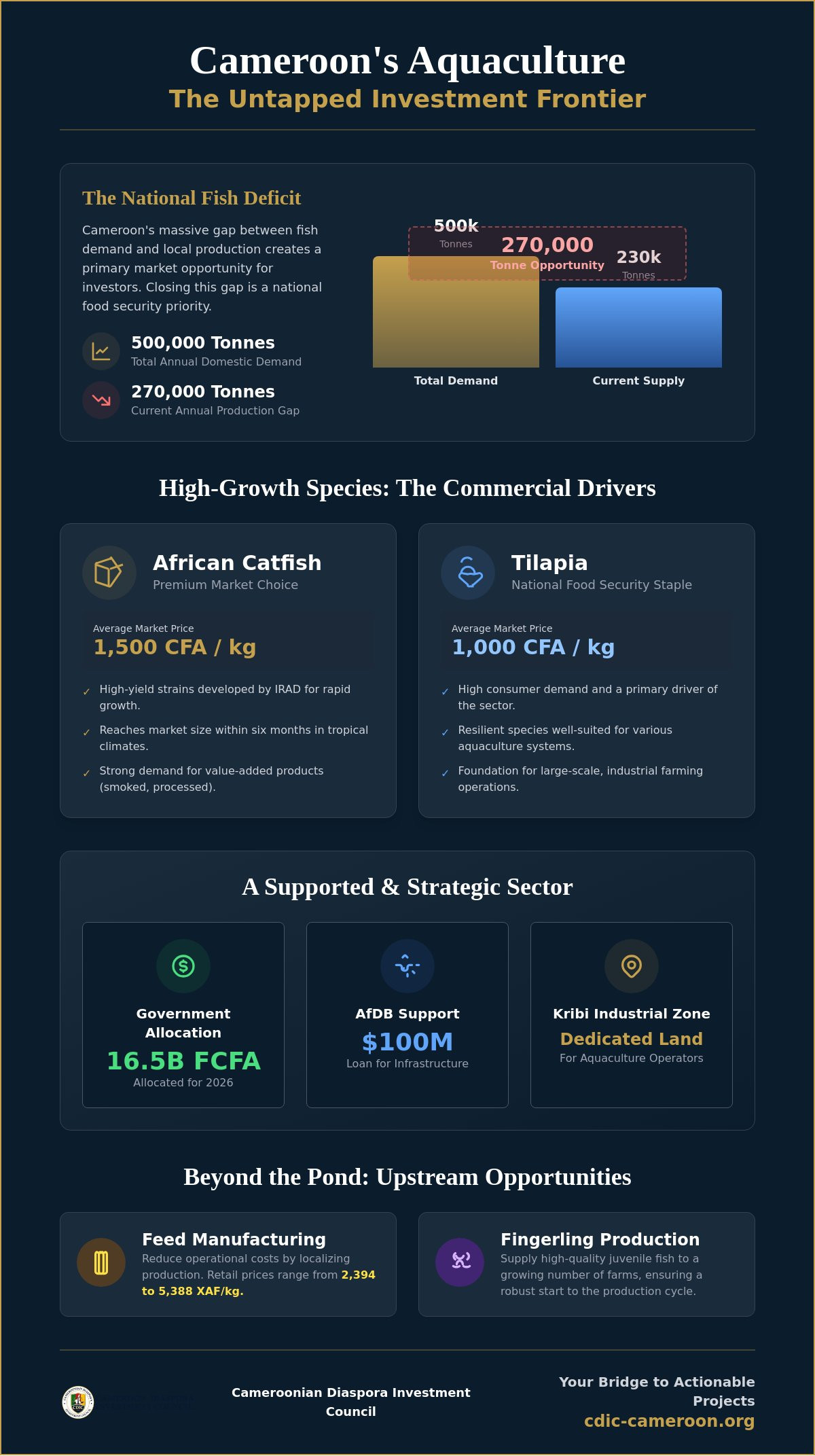
Cameroon currently imports approximately 180,000 tonnes of fish annually to satisfy a domestic demand that reaches 500,000 tonnes. This staggering 270,000-tonne production gap represents a massive, untapped frontier for aquaculture investment in Cameroon. You likely recognize that this disparity is more than a food security concern; it’s a sophisticated commercial opening for those with the capital and vision to act. While the ambition to contribute is clear, we understand the hesitation often caused by fears of local mismanagement or the technical complexities of cold chain logistics.
This guide provides a strategic framework to help you leverage the country’s booming aquatic sector while ensuring your capital drives sustainable development. You’ll discover how to navigate the value chain by accessing institutional support, such as the 16.5 billion FCFA government allocation for 2026 and the dedicated investment plots in the Kribi Industrial Zone. By connecting with vetted professional networks and structured projects, you can mitigate operational risks and secure meaningful economic returns. We’ll examine the specific pathways for the diaspora to move from spectators to institutional leaders in Cameroon’s journey toward food self-sufficiency.
Key Takeaways
- Analyze the substantial market gap created by Cameroon’s current 270,000-tonne fish production deficit.
- Discover the commercial potential of Tilapia and African Catfish as primary drivers for national food security.
- Evaluate the strategic advantages of the Kribi Industrial Zone, which currently offers dedicated land for aquaculture operators.
- Master risk mitigation strategies for aquaculture investment in Cameroon by vetting local partners through institutional frameworks.
- Leverage the CDIC Investor Portal and Individual Membership to transform your capital into a professionally managed, high-impact project.
The Economic Landscape: Why Aquaculture Investment in Cameroon is Rising
Cameroon’s economic landscape is undergoing a profound structural realignment. Central to this evolution is the urgent need to address a massive fish import bill that depletes foreign reserves and undermines national sovereignty. Currently, the nation imports roughly 180,000 tonnes of fish annually to meet a 500,000-tonne demand. This 270,000-tonne deficit isn’t just a logistical challenge; it’s a clear commercial signal for aquaculture investment in Cameroon. The government’s Vision 2035 framework prioritizes food self-sufficiency, transitioning the sector from subsistence-level fishing to high-output industrial operations. This shift represents a move toward systemic resilience and professionalized production cycles.
The professionalization of this industry was on full display at the 2026 Interprofessional Aquaculture Exhibition (SIAC). This landmark event signaled a maturing ecosystem where modern technology meets local expertise. It’s no longer about small-scale survival. It’s about strategic, scalable enterprise. For the global diaspora, this maturation offers a unique entry point into a sector that is institutionally backed and increasingly transparent.
Bridging the National Food Security Gap
The reliance on imported frozen fish has created a market hungry for fresh, locally produced alternatives. Consumers across the country’s urban centers increasingly value quality and provenance, yet the supply remains insufficient to meet daily needs. Diaspora investment serves as the essential catalyst here. By injecting capital and global management standards, the diaspora can transform local production into a robust commercial engine. This growth doesn’t just benefit the bottom line. It drives rural job creation and empowers communities by providing stable, skilled employment in pond management, processing, and distribution. It’s a model where economic returns and social impact are inextricably linked.
Institutional Backing and Global Interest
Stability in this sector is reinforced by significant international support and dedicated funding. A USD 100 million loan from the African Development Bank (AfDB) has anchored the infrastructure necessary for large-scale growth. Much of this funding flows through the PD-CVEP project, which focuses on distributing high-yield broodstock and improving technical capacity for producers. International development NGOs now view Cameroon as a primary site for the “Blue Transformation,” a global movement to enhance the sustainability of aquatic food systems. This institutional backing provides a layer of security for those looking to enter the market. It ensures that aquaculture investment in Cameroon is supported by a framework of professional governance and strategic foresight.
High-Growth Sub-sectors: Tilapia, Catfish, and Beyond
Identifying the right biological asset is the first step toward a resilient portfolio. While the market is diverse, Tilapia and African Catfish (Clarias) remain the primary drivers of commercial success in the region. These species don’t just offer biological stability; they command premium prices in urban centers like Douala and Yaoundé. As of June 2026, the average selling price for Tilapia sits at 1,000 CFA francs per kilogram, while Catfish commands a higher premium at 1,500 CFA francs per kilogram. These figures reflect a robust consumer demand that consistently outstrips local supply.
Success in aquaculture investment in Cameroon isn’t limited to the fish themselves. The “upstream” value chain offers significant openings, particularly in fingerling production and specialized feed manufacturing. With retail fish pellets ranging from 2,394 to 5,388 XAF per kilogram, localizing feed production presents a massive opportunity to reduce operational overhead for large-scale farms. Investors are also increasingly exploring integrated farming systems. By combining fish production with crop irrigation, operators can maximize land utility and create circular nutrient cycles that enhance overall farm profitability.
The African Catfish Advantage
The Agricultural Research Institute for Development (IRAD) has pioneered high-yield strains that offer investors a significant biological edge. The Clarias strain exhibits remarkable resilience and rapid weight gain in Cameroon’s tropical climate, often reaching market size within six months. Beyond fresh sales, there’s a growing demand for smoked and processed catfish in urban markets. This processing layer adds value and extends shelf life, effectively mitigating the risks associated with immediate post-harvest sales. It’s a sub-sector where technical precision meets high market liquidity.
Tilapia Farming and Industrial Scalability
Tilapia production offers a path to industrial-scale operations, particularly through cage farming in the country’s reservoirs or intensive pond systems. While pond systems are excellent for controlled growth, cage farming allows for higher density and scalability suitable for regional export within the CEMAC zone. Achieving these yields requires a rigorous focus on feed quality and water management. According to data on Fisheries and Aquaculture in Cameroon, the transition to intensive systems is heavily dependent on consistent, high-protein nutrition and professionalized hatchery management.
Solving the cold chain logistics gap remains the final frontier for diaspora investors. Those who can provide reliable refrigeration and transport will secure a dominant position in the distribution network. To begin vetting specific projects in these high-growth areas, consider registering for an Individual Membership to access our curated list of sustainable opportunities.
Strategic Locations: The Kribi Industrial Zone and Beyond
Geography is the silent partner in every successful commercial venture. In the context of aquaculture investment in Cameroon, your choice of location determines your logistical efficiency, your species selection, and your ultimate scalability. While the country’s diverse climate offers multiple entry points, two distinct models have emerged: coastal industrial hubs and inland regional centers. Each offers unique advantages depending on whether your focus is on high-volume processing for export or supplying the dense urban markets of the interior.
Infrastructure requirements must be a primary consideration during your site selection process. Reliable electricity is non-negotiable for aeration systems and cold chain maintenance; similarly, proximity to modern road networks is essential to minimize post-harvest losses. By aligning your project with existing government-backed infrastructure projects, you can significantly reduce the initial capital expenditure required for land preparation and utility connection. It’s a matter of placing your capital where the path to market is already being paved.
The Kribi Advantage: Export-Ready Infrastructure
The Kribi Industrial Zone (PAK) has rapidly become the crown jewel of Cameroon’s industrial strategy. In June 2026, a landmark partnership was signed between the Ministry of Livestock, Fisheries and Animal Industries (MINEPIA) and the Port Authority of Kribi to promote maritime aquaculture. As part of this agreement, the PAK has allocated 10 dedicated plots specifically for aquaculture operators. This location offers unparalleled access to deep-sea port facilities, making it the strategic choice for investors aiming for future regional or international exports. The administrative facilitation provided within the zone streamlines the process of securing permits and environmental clearances, allowing for a faster transition from planning to production, while reflecting the technical excellence seen in other professional marine sectors like Cozumeldivehub.
Regional Hubs for Inland Production
Inland production remains the backbone of national food security, with Yaoundé and Bamenda serving as critical hubs for hatchery management and distribution. The cooler water temperatures in high-altitude regions like Bamenda are particularly conducive to specialized fingerling production. These areas benefit from a long history of technical expertise centered around the Foumban and Bamenda research stations. The African Development Bank’s livestock and fish farming value chain development project has been instrumental in modernizing these stations, providing a blueprint for private-sector expansion. While land costs in these rural heartlands are often more accessible, the proximity to major urban centers ensures that logistics costs remain manageable and market demand stays high.
Risk Mitigation and Strategic Due Diligence
Risk is an inherent component of any high-growth frontier. For the diaspora, the primary barriers to aquaculture investment in Cameroon often center on the fear of operational mismanagement and the lack of verifiable data from the ground. Transitioning from a position of “blind trust” to one of “institutional oversight” requires a structured approach to due diligence. By implementing rigorous vetting processes and leveraging modern monitoring frameworks, you can protect your capital while ensuring your project meets professional standards of excellence. It’s about building a system where transparency is the default, not the exception.
Diversification across the aquaculture value chain serves as an additional layer of protection. Rather than concentrating all resources into a single production cycle, strategic investors often spread exposure across hatchery management, feed distribution, or cold chain logistics. This multi-faceted approach ensures that even if one segment faces a seasonal downturn, the overall portfolio remains resilient. Strategic intelligence, in this context, means understanding that the most stable returns often lie in the infrastructure that supports the fish, rather than just the fish themselves.
A Framework for Due Diligence
Successful entry into the Cameroonian market demands a methodical verification process. Before committing capital, investors should follow a three-tiered audit framework:
- Step 1: Legal Verification. Confirm the authenticity of land titles and ensure the project has obtained all necessary MINEPIA certifications and environmental permits.
- Step 2: Technical Assessment. Conduct independent audits of water sources and soil quality to ensure the site can support intensive production cycles without ecological degradation.
- Step 3: Partner Vetting. Review the operational track record and financial history of local technical partners to ensure their expertise aligns with your commercial objectives.
Technological Oversight for the Diaspora
Modern technology has effectively bridged the geographical gap between the investor and the pond. Utilizing IoT sensors allows you to monitor water quality, oxygen levels, and feed consumption in real time from any location in the world. These digital footprints provide a level of transparency that traditional reporting cannot match. Furthermore, financial integrity is maintained through structured digital payment systems and automated reporting tools. The CDIC Investor Portal plays a critical role here, acting as a centralized hub for finding projects that have already undergone a baseline level of institutional vetting. This platform reduces the “information asymmetry” that often plagues diaspora investments, providing a clear path to realized potential.
Securing your legacy in this sector requires more than just capital; it requires the right institutional partners. To begin your journey with a vetted framework, register for Investor Portal Registration today and gain access to our curated list of professional aquaculture opportunities.
The CDIC Bridge: Turning Ideas into Actionable Projects
Execution is the true differentiator between a missed opportunity and a successful venture. While the biological and geographical advantages of aquaculture investment in Cameroon are evident, the path to realization requires a structured, institutional framework. The Cameroonian Diaspora Investment Council (CDIC) serves as this essential link. We provide the tools, the network, and the vetting processes necessary to transform liquid capital into sustainable, high-impact aquatic infrastructure. Our mission is to move beyond the traditional “remittance” model toward a sophisticated strategy of “investing forward.”
Individual and Corporate Memberships act as the primary gateway to this ecosystem. Through these tiers, members gain access to a curated professional network that prioritizes transparency and strategic intelligence. The CDIC Service Provider Portal allows you to identify and connect with trusted local experts, from technical pond engineers to legal specialists. Additionally, the CDIC Ambassador Program offers a leadership platform for those who wish to champion national development at a systemic level. This is where global vision meets local execution.
Accessing the Investor Portal
The Investor Portal is the central nervous system of our operations. Here, we identify and present aquaculture initiatives that have undergone preliminary due diligence to ensure they align with our standards of sustainability and economic viability. For many in the diaspora, collective investment models represent the most effective way to participate in larger-scale industrial projects, such as specialized feed mills or cold chain logistics hubs. These models allow for shared risk and pooled expertise, creating a more stable environment for growth. To understand the full scope of these opportunities, you should consult Empowering the Vision: The Definitive Guide to Cameroon Diaspora Membership (2026).
Joining a Global Network of Visionaries
Success in the aquaculture sector is not a solitary pursuit. It requires a commitment to unity and a shared responsibility for Cameroon’s economic future. By joining this network, you’re not just funding a farm; you’re anchoring a national movement toward food self-sufficiency and the realization of Vision 2035. We invite you to move from the sidelines of observation to the front lines of national transformation. The time to secure your position in this booming sector is now. Complete your Investor Portal Registration today to begin your journey and explore vetted opportunities for aquaculture investment in Cameroon.
Securing Your Legacy in Cameroon’s Blue Economy
The transition from a net importer to a regional aquaculture powerhouse is already underway. By identifying the massive domestic production deficit and leveraging strategic hubs like the Kribi Industrial Zone, you’re positioning your capital at the heart of a national transformation. Realizing the full potential of aquaculture investment in Cameroon requires a shift from passive observation to active, structured participation. This isn’t merely about individual profit; it’s about institutionalizing progress and ensuring food security for future generations.
CDIC acts as your strategic facilitator for Vision 2035, providing the essential link between diaspora ambition and local execution. Through our global network of professional Cameroonians and our vetted Investor and Service Provider portals, we offer the transparency and oversight necessary for long-term success. The path to a resilient, self-sufficient economy is clear, and it begins with your decision to lead. We invite you to Join CDIC and Access Vetted Aquaculture Opportunities today. The future of our nation is being built by those with the courage to invest in its potential.
Frequently Asked Questions
Is aquaculture investment in Cameroon profitable for the diaspora?
Profitability is driven by a significant supply-demand gap, as the nation currently faces an annual deficit of 270,000 tonnes of fish. Market prices reflect this scarcity; as of June 2026, fresh catfish sells for approximately 1,500 CFA francs per kilogram, while tilapia averages 1,000 CFA francs per kilogram. These margins, combined with a 500,000-tonne national demand, create a robust environment for aquaculture investment in Cameroon to generate meaningful economic returns.
What are the best fish species to farm for commercial success in Cameroon?
Tilapia and African Catfish (Clarias) are the most viable species for commercial operations due to their rapid growth cycles and high market acceptance. The Agricultural Research Institute for Development (IRAD) provides specialized broodstock that is optimized for local conditions. While tilapia is ideal for high-volume pond or cage systems, catfish offers greater resilience and higher price points in urban processing centers.
How can I ensure my investment is safe if I live abroad?
Safety is achieved through a combination of institutional vetting and modern oversight technology. Utilizing IoT sensors allows you to monitor water quality and feed logs in real time from any global location. By working through structured platforms like the CDIC Investor Portal, you ensure that your capital is directed toward projects that have already undergone rigorous technical and legal due diligence.
What government incentives are available for aquaculture investors?
The Cameroonian government offers substantial fiscal advantages through Ordinance No. 2025/004, which includes corporate tax exemptions for up to 10 years. Additionally, Ordinance No. 2025/002 provides tax credits ranging from 25% to 80% of the total investment for agro-industrial projects. Investors also benefit from customs franchises on all imported technical equipment, significantly reducing initial setup costs.
Do I need a local partner to start a fish farm in Cameroon?
While a local partner isn’t a strict legal requirement for all business structures, having a vetted technical manager is highly recommended for day-to-day operations. The CDIC Service Provider Portal connects you with professional experts who understand the local regulatory and biological landscape. This approach allows you to maintain strategic control while leveraging specialized on-the-ground expertise.
How does CDIC help me find vetted aquaculture projects?
CDIC acts as a strategic bridge by matching members with high-impact opportunities through our Investor Portal. We conduct the preliminary due diligence to verify land titles, environmental permits, and the operational capacity of project developers. Accessing these curated opportunities requires an Individual Membership, which serves as the professional gateway for diaspora engagement.
What is the minimum capital required for a commercial fish farm?
Initial capital requirements vary based on scale, but baseline data from July 2025 indicates that constructing three 50-cubic-meter fish ponds costs approximately 4.5 million CFA francs. Fingerlings are typically priced at 125 CFA francs each. These figures provide a foundational benchmark, though industrial-scale operations in specialized zones will require a more comprehensive capital structure to account for advanced infrastructure and cold chain logistics.
Can I invest in aquaculture through the Kribi Industrial Zone?
Yes, the Kribi Industrial-Port Zone (PAK) is currently a primary hub for aquaculture investment in Cameroon. Following a June 2026 agreement with the Ministry of Livestock, Fisheries and Animal Industries (MINEPIA), 10 plots of land have been specifically allocated for aquaculture investors. This zone offers unique advantages, including direct port access and streamlined administrative services for export-oriented businesses.