From summit participation to a practical pipeline for diaspora investment, trusted service delivery, technology partnerships and market access
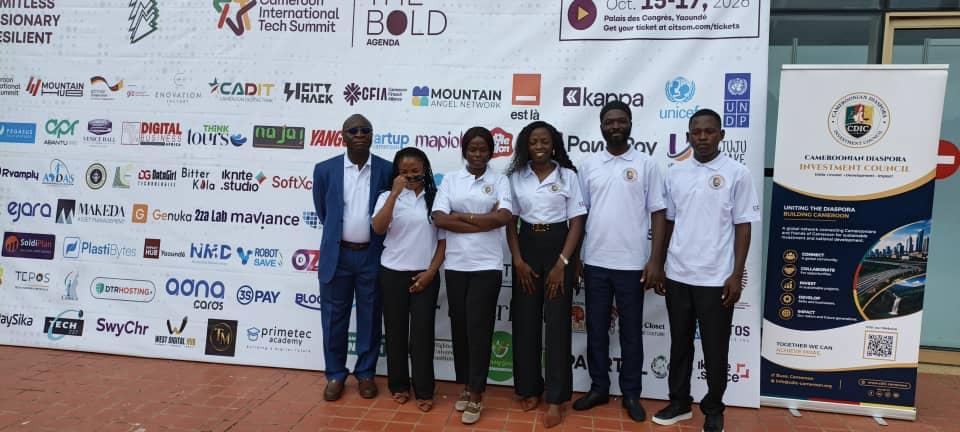
The Cameroonian Diaspora Investment Council (CDIC) took part in the second Cameroon International Tech Summit (CITS2026), held from 15 to 17 October 2026 at the Palais des Congrès in Yaoundé under the theme “The Bold Agenda”.
The summit brought together government representatives, private sector leaders, start-ups, investors, development partners and young innovators. The programme featured exhibitions, thematic panels, a national innovation bootcamp and a start-up pathway designed to move promising ventures closer to investment and commercial partnerships.
Why CDIC Was There
For CDIC, the value of the summit went well beyond attendance. The delegation used the three days to identify organisations whose work can strengthen the Council’s investment, project owner and service provider platforms, to open discussions with institutions interested in diaspora engagement, and to build a practical follow-up pipeline across finance, insurance, payments, artificial intelligence, digital infrastructure, health technology, skills development and entrepreneurship.
Discussions at the summit returned again and again to one national challenge: converting Cameroon’s large pool of educated young people into productive employment and internationally competitive businesses. That agenda sits very close to CDIC’s own role. Diaspora professionals can contribute far more than capital. They can introduce international clients, mentor founders, open outsourcing contracts, provide technical expertise and help credible Cameroonian enterprises reach foreign markets.
What Came Out of the Summit
Around 20 organisations were engaged across the two field reports, and a number of those conversations now warrant structured follow-up. The early opportunities include investor education and regulated market access, diaspora focused insurance, local and cross-border payment solutions, technology and engineering services, project sourcing, skills partnerships and SME investor matchmaking.
The summit also strengthened the Council’s national positioning. CDIC was introduced to organisations and professionals who had little or no previous awareness of its work, which opens a clear path to stronger visibility, member recruitment and institutional access.
CITS2026 confirmed a strong opportunity for CDIC to serve as a bridge between Cameroon’s growing innovation ecosystem and the capital, expertise, contracts and professional networks of the global Cameroonian diaspora.
Priority Partnership Opportunities
The organisations below emerged as the strongest immediate prospects. Naming them here records an opportunity for discussion. It does not constitute an endorsement, and any formal relationship will remain subject to verification, due diligence, legal review and approval by CDIC.
Elite Capital (Investment and capital markets). Explore investor education and access to regulated CEMAC capital market opportunities for diaspora members.
COVA Africa (Insurtech). Assess diaspora focused family protection and member benefit solutions.
Maviance / Smobilpay (Payments). Assess FCFA, Mobile Money and cross-border collection options for CDIC platform use.
PaySika / Swychr (Fintech). Evaluate complementary digital payment services and member facing financial technology solutions.
Summith (SME and investor ecosystem). Develop visibility, founder support and investor matchmaking collaboration. An initial podcast invitation has already been extended to CDIC.
MedVAULT (Health technology). Review for potential project pipeline and health sector innovation engagement.
Januko (Engineering and AI). Explore engineering, technology and outsourcing links with diaspora professionals and international clients.
Dynamic AI Nexus (AI consulting). Consider technology advisory work and potential registration within the CDIC Service Provider Directory.
A Wider Collaboration Pipeline
Beyond the priority prospects, the summit produced a broader pool of organisations that may support the Council’s service provider, education, connectivity, branding, workforce and agribusiness objectives. These include DTR Hosting, Hitech-cm, Bitter Kola Studio, Primetec Academy, SolidPlan and El Ankia Naturals, along with other exhibitors whose capabilities can be assessed against CDIC’s requirements.
The first participation report also records discussions with the International Organization for Migration and with organisations working on women’s digital inclusion, together with outreach to other institutional and private sector actors present at the summit. These conversations reinforce the case for a more deliberate CDIC partnership programme focused on diaspora mobilisation, technology skills, women and youth participation, and international market access.
Five Lessons We Are Taking Forward
Trust must remain central. The strongest role CDIC can play is to reduce uncertainty through verification, transparent information, structured introductions and disciplined due diligence.
Diaspora participation must go beyond remittances. Capital matters, but so do contracts, clients, mentoring, specialist knowledge and access to international markets.
Cameroon’s technology sector needs market access. Training and innovation are increasingly visible. Sustainable growth will depend on customers, commercial partnerships and investment readiness.
CDIC needs a stronger physical presence at major events. A dedicated stand, branded materials and an official speaking role would improve visibility, member recruitment, project sourcing and institutional access.
Partnerships should be converted into platform value. Every credible relationship should connect to a clear CDIC function, whether that is the Investor Portal, the Project Owners Portal, the Service Provider Directory, member benefits or education programmes.
What Happens Next
The report sets out a 90 day follow-up framework. In the first month, CDIC sends formal follow-up correspondence, schedules meetings with priority organisations and invites suitable firms and projects onto the relevant CDIC portals. In the second month, the focus moves to verification and due diligence, the selection of three to five partnership candidates, draft agreements where appropriate, and an online investor and entrepreneurship session for members. By the end of the third month, approved partnerships and verified listings are published, member and project engagement is measured, and planning begins for CITS27 with a CDIC stand and a proposed diaspora investment panel.
A Word on Due Diligence
CDIC draws a clear line between an initial contact, a partnership under discussion and a formally approved partnership. Claims made by prospective partners, including client lists, user numbers, licences, product performance and market reach, are independently verified before any public endorsement or platform listing. Financial sector relationships are presented as access to information and services, not as investment advice.
Read the Full Report
The public edition of the Participation and Strategic Partnership Report covers the summit programme in full, the complete list of priority partnership opportunities and the sectors they cover, the wider collaboration pipeline, what CDIC brings to future partners and the full 90 day action plan.