
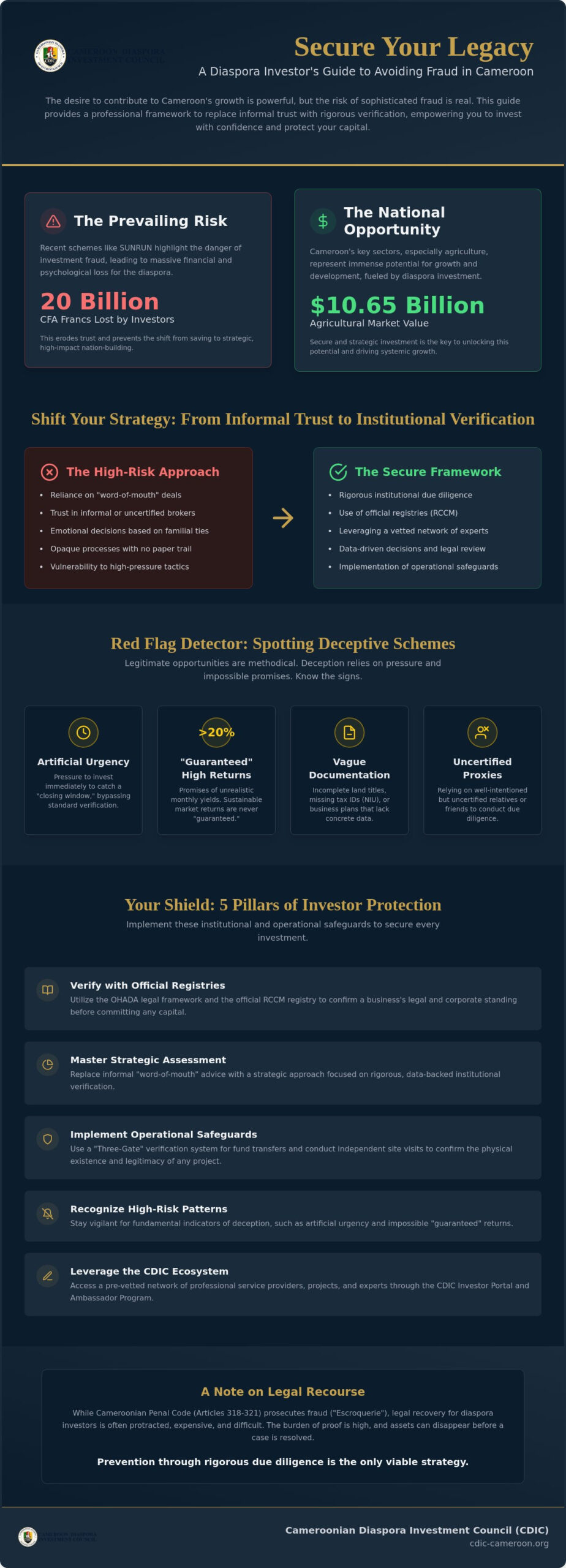
The SUNRUN Ponzi scheme recently defrauded investors of an estimated 20 billion CFA francs, illustrating the critical importance of avoiding investment fraud in Cameroon for the global diaspora. You likely feel a deep sense of duty to contribute to the nation’s 10.65 billion dollar agricultural market, yet the fear of losing your life savings to emotional manipulation or lack of transparency is a heavy burden. It’s difficult to transition from saving to growth when local registries feel opaque and informal brokers dominate the conversation.
This strategic guide empowers you with the professional frameworks and institutional safeguards necessary to secure your financial future. You’ll master the essential due diligence required to protect your capital and ensure your contributions drive genuine systemic growth. We’ll examine the role of the official RCCM registry, the CDIC Investor Portal, and the shift from “word-of-mouth” deals to a vetted network of experts. By replacing informal trust with rigorous verification, you can finally invest with the confidence of a global institutional leader.
Key Takeaways
- Utilize the OHADA legal framework and the official RCCM registry to verify a business’s corporate standing before committing capital.
- Recognize that high-risk patterns like artificial urgency and “guaranteed” returns are fundamental indicators of deceptive schemes.
- Master a strategic approach to avoiding investment fraud in Cameroon by replacing informal word-of-mouth deals with rigorous institutional verification.
- Implement operational safeguards, including a “Three-Gate” verification system for transfers and independent site visits to confirm project legitimacy.
- Leverage the CDIC Investor Portal and Ambassador Program to access a vetted ecosystem of professional service providers and development projects.
The Anatomy of Investment Fraud in Cameroon: 2026 Context
In the Cameroonian legal framework, investment fraud is fundamentally categorized under the term “Escroquerie.” It describes the deliberate use of false names, fraudulent maneuvers, or fictitious powers to obtain funds from unsuspecting victims. For the global diaspora, this challenge is compounded by a profound information asymmetry. You possess the liquidity and the emotional desire to contribute to your homeland, yet the physical distance creates a gap that bad actors are eager to fill. This vulnerability often leads to a reliance on informal channels rather than structured institutional verification.
The landscape of deception has evolved significantly. While early iterations of financial crime relied on clumsy communications, today’s bad actors utilize sophisticated digital platforms and polished real estate marketing to mirror legitimate opportunities. Understanding The Anatomy of Investment Fraud in Cameroon is the first step toward securing your legacy. Beyond the financial loss, the psychological cost of these deceptions is immense. It erodes the trust necessary for national development and prevents the diaspora from moving from simple saving to strategic, high-impact investing.
Common Manifestations of Financial Deception
Modern fraud often wears the mask of national progress. Fictitious real estate developments are a persistent threat, frequently involving “double-sold” land titles where multiple parties hold conflicting claims to the same plot. Similarly, unregulated agro-industrial schemes have emerged, promising monthly yields exceeding 20%. Such figures represent a mathematical impossibility in any stable commodity market. Digital currency and “fintech” platforms also present high risks, as many operate without the mandatory authorization from the Bank of Central African States (BEAC) or the Central African Banking Commission (COBAC). Without these regulatory approvals, your capital remains entirely unprotected.
The Legal Reality: Penal Code Articles 318-321
The Cameroonian Penal Code, specifically Articles 318 through 321, provides the legal basis for prosecuting “false pretenses.” However, the limitations of post-fraud legal action are stark. Cameroon operates on a unique bijural system that combines Civil Law and Common Law traditions. This complexity can make recovery a protracted and expensive ordeal for those residing abroad. Because the burden of proof is high and fraudulent assets are often liquidated before a court date, prevention remains the only viable strategy for global investors. Mastering the art of avoiding investment fraud in Cameroon requires a proactive shift. You must move away from reactive legal hope and toward a culture of rigorous institutional due diligence.
Recognizing High-Risk Scams and Deceptive Patterns
Deception often thrives in the shadows of “exclusive” opportunities. High-risk schemes typically rely on an artificial sense of urgency, pressuring you to bypass standard verification protocols. Legitimate capital allocation is methodical; it requires time for legal review and structural analysis. If a solicitor demands immediate, un-vetted cash under the guise of a “closing window,” it’s a definitive sign of a trap. This pattern is often paired with promises of “guaranteed” returns, sometimes exceeding 20% monthly. In any stable market, such yields are mathematically impossible. They serve only as bait for those seeking rapid wealth over sustainable growth. Developing a keen eye for these patterns is the first step toward avoiding investment fraud in Cameroon.
The “relative” factor remains one of the most complex hurdles for the diaspora. While family members often act with good intentions, they rarely possess the professional certification required to conduct deep due diligence. Relying on an uncertified proxy increases the risk of capital loss significantly. Sophisticated bad actors often use these emotional connections to bypass your skepticism. Professionalizing your investment approach is the most effective method for avoiding investment fraud in Cameroon. By moving beyond familial trust and toward institutional oversight, you protect both your wealth and your relationships.
Red Flags in Project Documentation
Authentic business opportunities in Cameroon are anchored in verifiable paperwork. A primary red flag is an incomplete or “unofficial” land title (titre foncier) that lacks valid government stamps or a clear chain of ownership. Additionally, look for these specific omissions:
- Missing NIU: Every legitimate soliciting entity must possess a unique Taxpayer Identification Number.
- Vague Business Plans: Documentation that omits operational costs or fails to address local risk factors is likely a fabrication.
- Unofficial Stamps: Legitimate documents must be notarized or issued by the appropriate ministry.
You can verify these details through the Service Provider Portal, which connects you with vetted legal counsel.
Digital and Social Engineering Tactics
Modern fraud leverages digital intimacy to build false credibility. Bad actors frequently impersonate government officials or institutional leaders on messaging apps to solicit funds. Recognizing High-Risk Scams involving business email compromise and digital impersonation is critical, as these tactics have led to severe international legal consequences. Be wary of “social proof” in closed WhatsApp groups, where fake testimonials create a false consensus. Even founder interviews may now be manipulated using deepfake technology. Always verify the physical existence of assets through independent site visits or trusted third-party ambassadors before authorizing any transfer.
A Rigorous Framework for Verifying Business Legitimacy
The OHADA legal framework serves as the structural bedrock for secure capital entry into Central Africa. By harmonizing business laws across seventeen member states, it provides a predictable environment where corporate existence is not a matter of trust, but of public record. Utilizing this framework is the most effective strategy for avoiding investment fraud in Cameroon. You shouldn’t rely on the word of a promoter when the Registre du Commerce et du Crédit Mobilier (RCCM) offers a definitive account of a firm’s legal standing. This registry tracks every company from its inception, recording its capital structure, registered office, and any legal encumbrances. It provides the clarity you need.
Strategic investors recognize that verifying the Ultimate Beneficial Owner (UBO) is non-negotiable. While a local company may appear legitimate on paper, identifying the individuals who wield actual control is essential for risk mitigation. The U.S. Department of State’s 2024 Investment Climate Statement highlights the complexities of the local legal regime and the importance of due diligence in navigating corruption and political influence. By cross-referencing claims with official government lists of licensed financial institutions, you replace ambiguity with institutional clarity. This methodical approach ensures that your capital supports legitimate growth rather than disappearing into opaque, un-vetted entities.
Step-by-Step Corporate Verification
Your verification process must begin with a formal request for an RCCM extract. This document confirms the entity’s registration and provides a “Certificate of Non-Bankruptcy,” proving the company is in good standing. For specialized sectors like mining or finance, you must verify professional licenses directly with the relevant ministry. If you lack the local presence to perform these checks, utilize the CDIC Service Provider Portal to connect with vetted legal counsel. These professionals understand the nuances of the OHADA system and can verify the validity of government stamps and signatures. They act as your eyes on the ground.
Financial and Regulatory Compliance
Any project involving capital management or collective investment must possess authorization from the Bank of Central African States (BEAC) or the Central African Banking Commission (COBAC). Without these regulatory seals, an entity is operating outside the law. Confirming the tax compliance status of a potential partner is equally critical to ensuring you don’t inherit systemic liabilities. Many fraudulent operations exist as “Ghost Companies,” shell entities designed solely for money laundering or capital flight. Rigorous financial vetting ensures that your resources are channeled into productive assets that contribute to the national GDP rather than being siphoned off by illicit actors. Clarity drives confidence.
Operational Safeguards: Protecting Your Capital from Abroad
Securing your financial interests requires a transition from passive trust to active operational discipline. While understanding the legal landscape is essential, the physical distance between the diaspora and local projects necessitates a “Three-Gate” verification system for all international transfers. This methodology ensures that capital is only released after pre-transfer legal validation, placement into a secure escrow or milestone-based account, and final verification of project progress. By implementing these structural barriers, you move toward a standard of excellence in avoiding investment fraud in Cameroon. Legitimate developers will respect this professional rigour; those who resist it are often signaling a lack of transparency.
Physical verification remains the ultimate antidote to digital deception. If you cannot personally visit a site in Douala, Yaoundé, or the rural agricultural belts, you must rely on a vetted proxy. The CDIC Ambassadors Program provides this essential local oversight, offering a bridge for global investors who require boots-on-the-ground confirmation. Every agreement must also be formalized through a Notary Public (Notaire) recognized by the State. In the Cameroonian system, certain contracts, particularly those involving land or corporate restructuring, are only legally binding when executed before a Notaire. Skipping this step leaves your investment without the institutional protection it deserves.
The 5-Step Due Diligence Checklist
- Independent Registry Check: Verify the RCCM registration and Taxpayer Identification Number (NIU) through official channels, not just provided PDFs.
- Professional Vetting: Engage an independent Cameroonian lawyer via the Service Provider Portal to review all contracts before signing.
- Physical Verification: Commission a professional site audit or use drone surveys to confirm that infrastructure and land developments actually exist.
- Financial Protocol: Never send investment capital to personal bank accounts. In 2021 alone, Cameroon lost 12.2 billion CFA francs to cybercrime and phishing; institutional accounts are your primary defense.
- Institutional Alignment: Consult with the CDIC before finalizing large-scale commitments to ensure the project aligns with vetted development standards.
Mitigating the ‘Family Tax’ Risk
Emotional connection is a powerful motivator, yet it often clouds professional judgment. To protect your capital, you must strictly separate humanitarian “giving back” from strategic business investment. Treat your relatives as stakeholders only if they possess the requisite professional qualifications. Standardizing your communication is a critical first step; move away from personal chat apps and utilize professional email threads to maintain a clear audit trail of all decisions and promises. To further professionalize your approach and access a network of like-minded experts, consider applying for CDIC Individual Membership. This transition from informal support to structured investment is the hallmark of a sophisticated global citizen.
Ready to move from saving to strategic investing? Register for the CDIC Investor Portal today to access a curated database of vetted development projects.
Institutional Protection: Leveraging the CDIC Ecosystem
Individual vigilance is the foundation of security, yet the most effective defense against systemic risk is institutional alignment. The Cameroonian Diaspora Investment Council (CDIC) operates as a sophisticated facilitator, bridging the gap between global capital and local opportunity. By centralizing the due diligence process within a professional framework, the CDIC ensures that your capital is matched with projects that have undergone rigorous institutional scrutiny. This collective approach transforms the solitary task of avoiding investment fraud in Cameroon into a shared mission of integrity and national growth. You no longer have to navigate the complexities of the local market in isolation.
The power of the CDIC ecosystem lies in its ability to replace informal “word-of-mouth” deals with a structured, transparent methodology. This transition is critical for a nation where agribusiness alone contributes 22% to the national GDP and represents a 10.65 billion dollar market value. Strategic intelligence is gathered through a global network of peers and local experts, ensuring that every investment decision is backed by verified data. By leveraging this institutional bridge, you move beyond the limitations of personal connections and tap into a professionalized stream of development projects that are built for long-term sustainability.
Vetting via the Investor and Service Provider Portals
The CDIC Investor Portal serves as a curated gateway to legitimacy. Every project listed undergoes a comprehensive pre-screening process that evaluates its legal standing, financial viability, and operational transparency. This oversight is reinforced by the Service Provider Portal, which connects you with a vetted directory of legal, financial, and technical professionals who understand the unique requirements of the diaspora. Central to this intelligence network is the CDIC Ambassadors Program. These individuals provide the essential “boots on the ground” required to maintain real-time project transparency and verify that local operations align with their documented claims. They act as the final gatekeeper for your capital.
Join the Movement: From Victim to Visionary
The shift from informal remittances to institutional investment is more than a financial strategy; it’s a commitment to the future of Cameroon. When you move your capital through professionalized channels, you contribute to a more transparent and attractive investment climate for all. Your membership in this movement signals a rejection of the “get-rich-quick” schemes that have historically hindered progress. By adopting these institutional safeguards, you protect your heritage and ensure your resources drive genuine impact. It’s time to move from the fear of loss to the confidence of strategic execution. Register for the CDIC Investor Portal Today and secure your place in Cameroon’s growth story.
Securing Your Legacy Through Institutional Excellence
The transition from capital preservation to strategic wealth creation requires a fundamental shift in perspective. You’ve explored the necessity of replacing informal word-of-mouth deals with the structural rigour of the OHADA framework and the RCCM registry. By mastering these due diligence frameworks and implementing milestone-based operational safeguards, the process of avoiding investment fraud in Cameroon becomes a manageable professional standard rather than an emotional burden. It’s about protecting your hard-earned savings while ensuring your contributions drive genuine national progress.
The path toward sustainable impact is built on collective intelligence and institutional oversight. As a mission-driven NGO, the CDIC provides the strategic bridge you need to navigate local complexities with confidence. Through our specialized Investor Portal and a global network of CDIC Ambassadors, we offer the local oversight and project matching required for long-term success. Secure your future—Join the CDIC and access vetted investment opportunities today. Your commitment to excellence ensures a more transparent and prosperous tomorrow for the entire diaspora community.
Frequently Asked Questions
Is it safe to invest in Cameroonian real estate without being physically present?
Investing in Cameroonian real estate without a physical presence is high-risk unless you utilize institutional safeguards. You must rely on a vetted proxy, such as a CDIC Ambassador, to conduct site visits and verify the authenticity of the titre foncier. Relying solely on digital photos or uncertified relatives often leads to land title disputes or “double-sold” properties. Professional oversight is the only way to ensure your capital is anchored in legitimate assets.
Can I verify a Cameroonian company’s registration status online?
You can verify a company’s registration status through the official OHADA portal at rccm.ohada.org. This platform provides access to the Registre du Commerce et du Crédit Mobilier (RCCM), allowing you to confirm a firm’s legal existence and capital structure. For a more detailed analysis, you should obtain an electronic RCCM extract. This step is a fundamental requirement for avoiding investment fraud in Cameroon and protecting your financial interests.
How do I know if an investment opportunity in Cameroon is a Ponzi scheme?
Identifying a Ponzi scheme requires looking for “guaranteed” monthly returns exceeding 20% and a lack of transparent operational data. Legitimate agricultural or industrial projects face market fluctuations and post-harvest losses, which reach 40% for some perishable crops. If an entity promises consistent, high-yield payouts without explaining the underlying value creation, it’s likely a deceptive scheme designed to recruit new capital to pay earlier investors.
What should I do if I have already been a victim of investment fraud in Cameroon?
If you’ve been a victim of fraud, you should immediately document all communications and report the incident to the National Agency for Information and Communication Technologies (ANTIC) or local law enforcement. While the Cameroonian Penal Code criminalizes “Escroquerie” under Articles 318 to 321, recovery is often a protracted process. Consulting with a vetted lawyer through the CDIC Service Provider Portal can help you evaluate the feasibility of pursuing a criminal case.
What is the role of a Notary Public (Notaire) in preventing fraud?
A Notary Public (Notaire) acts as a state-recognized officer who authenticates legal deeds, particularly for real estate transfers and corporate formations. In Cameroon, certain transactions are only legally valid if executed before a Notaire. Their involvement ensures that documents are properly filed with the government, providing a critical layer of protection against the falsification of land titles or corporate minutes. They’re essential for establishing a clear, legal audit trail.
How does the CDIC verify the projects listed on its Investor Portal?
The CDIC employs a multi-layered vetting process that includes legal verification of RCCM documents, financial health audits, and physical site inspections via our Ambassador Program. We ensure that every project on our Investor Portal aligns with national development goals and possesses the necessary BEAC or COBAC authorizations. This institutional oversight provides the diaspora with a curated database of legitimate, high-impact opportunities, significantly aiding in avoiding investment fraud in Cameroon.
What are the specific BEAC regulations regarding diaspora investment?
BEAC regulations require all international capital transfers for investment purposes to be declared and processed through authorized financial intermediaries. For investments exceeding 100 million CFA francs, specific reporting requirements apply to ensure compliance with regional anti-money laundering standards. Understanding these rules ensures your capital entry is legally recognized within the CEMAC zone and protects you from the legal complications that often accompany informal or unregulated transfers.
Can I use international escrow services for business deals in Cameroon?
You can use international escrow services, but it’s vital to ensure they’re recognized within the Cameroonian legal framework or used in conjunction with a local Notaire. Milestone-based payments are a highly effective method for mitigating project risk. Releasing funds only after verified project stages protects your capital from being siphoned off by fraudulent actors who rely on upfront, un-vetted cash transfers to fuel their schemes.