
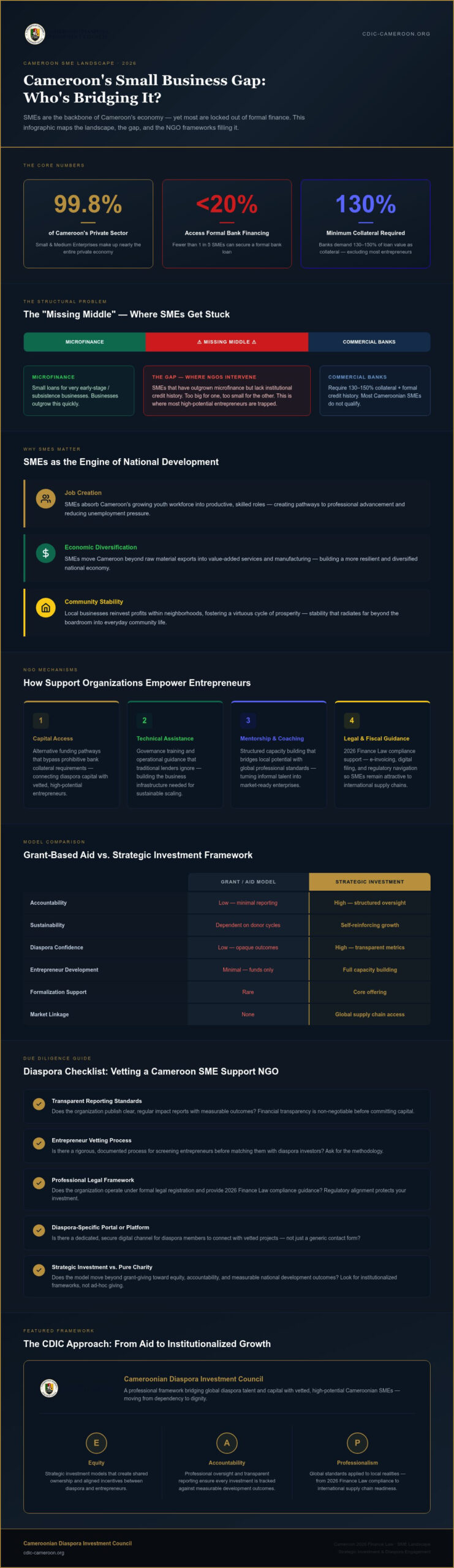
Did you know that while small and medium enterprises constitute 99.8% of Cameroon’s private sector, fewer than 20% of these businesses can access formal bank financing? This gap represents a significant barrier to progress, yet it also highlights a profound opportunity for a Cameroon small business support NGO to facilitate meaningful change. You likely recognize the immense potential within the heartland, but the fear of opaque operations and the difficulty of vetting legitimate entrepreneurs often make direct investment feel like a gamble. It’s exhausting to navigate informal channels when you’re seeking professional, high-impact growth.
This article identifies the premier organizations currently redefining how the diaspora engages with local markets through strategic investment and mentorship. We’ll explore how these facilitators provide the transparency and professional frameworks required to move beyond charity and toward sustainable, institutionalized success. You’ll discover vetted platforms that connect your resources with high-potential entrepreneurs, ensuring your capital contributes to measurable national development under the 2026 Finance Law. We provide a structured roundup of the visionary partners bridging the distance between global talent and Cameroonian SME realization.
Key Takeaways
- Understand the strategic shift from traditional humanitarian aid toward entrepreneurship-led economic transformation as a catalyst for sustainable national growth.
- Identify the core transparency and reporting standards required to effectively vet a Cameroon small business support NGO before committing professional capital.
- Compare the long-term impact of grant-based models against strategic investment frameworks to determine which approach best aligns with your vision for development.
- Explore how structured capacity building, including mentorship and professional coaching, bridges the gap between local potential and global standards.
- Discover how specialized portals facilitate secure connections between diaspora talent and vetted, high-potential entrepreneurs within the Cameroonian market.
The Landscape of Small Business Support: Why NGOs are Vital for Cameroon
The economy of Cameroon stands at a pivotal junction where traditional models of development are yielding to a more dynamic, entrepreneur-led paradigm. For decades, the focus remained on large-scale infrastructure or raw material exports, often leaving the most vibrant segment of the population behind. Today, a dedicated Cameroon small business support NGO acts as a vital intermediary, transforming how the diaspora and local stakeholders interact with the market. This shift represents a move away from passive aid toward active, strategic investment. It’s a transition from dependency to dignity.
Many businesses find themselves trapped in the “missing middle.” They’ve outgrown microfinance but lack the institutional history required by commercial banks. This structural gap stifles growth and limits the potential of high-achieving entrepreneurs. By providing a framework for vetting and professionalization, NGOs ensure these enterprises don’t just survive but scale into national champions. In 2026, SMEs represent the most significant opportunity for national progress because they possess the agility to adapt to digital shifts and local market demands that larger entities often overlook.
SMEs as the Engine of National Development
With small and medium enterprises accounting for 99.8% of the private sector, they’re the primary architects of national resilience. They’re not just businesses; they’re the primary source of employment for Cameroonian youth, offering a pathway to professional advancement. Their impact includes:
- Job Creation: Absorbing the growing workforce into productive, skilled roles.
- Economic Diversification: Moving beyond raw material exports into value-added services and manufacturing.
- Community Stability: Reinvesting profits locally to foster neighborhood prosperity.
Small business resilience contributes to overall community stability. When a local business thrives, it creates a virtuous cycle of prosperity that reaches far beyond the boardroom.
The Gap NGOs Fill: Beyond Traditional Banking
Accessing capital in the current environment remains a significant hurdle. Local commercial banks often demand collateral reaching 130% to 150% of the loan amount, a requirement that excludes most talented entrepreneurs. A specialized Cameroon small business support NGO addresses this by providing more than just capital. They offer the technical assistance and governance training that traditional lenders ignore. This holistic approach builds the necessary trust between the global diaspora and local projects. It ensures that every investment is backed by professional oversight and a clear path to execution, bypassing the bureaucratic inertia of traditional financial systems.
Mechanisms of Empowerment: How Leading NGOs Support Cameroonian Entrepreneurs
Empowerment in the Cameroonian context requires a multifaceted strategy that extends beyond simple liquidity. A professional Cameroon small business support NGO acts as a catalyst for systemic change, aligning global resources with local operational realities. These organizations don’t just provide funds; they build the infrastructure for sustainable growth. This involves a transition from traditional aid to a model based on equity, accountability, and professional standards. By creating these structured environments, NGOs enable entrepreneurs to move from the informal sector into the formal economy, where they can access broader markets and more significant opportunities.
The power of professional networks is particularly evident when navigating local regulatory hurdles. With the implementation of the 2026 Finance Law, compliance has become a complex requirement for many SMEs. Leading support organizations provide the legal and fiscal guidance necessary to manage e-invoicing and digital filing requirements. This professionalization ensures that businesses are not only compliant but also attractive to international supply chains. Connecting local producers with these global networks is essential for diversifying the national economy and reducing reliance on raw material exports.
Financial Support and Resource Mobilization
The shift from consumption-based remittances to strategic investment is fundamental to long-term resilience. Diaspora members are increasingly seeking ways to generate sustainable impact rather than providing one-off financial assistance. Transparent fund management serves as the cornerstone of this transition. By utilizing grant-matching or micro-investment models, an effective Cameroon small business support NGO provides a layer of security that encourages larger capital commitments. This mobilization of resources is a central theme within the U.S.-Cameroon economic partnership, which emphasizes empowering young entrepreneurs through structured financial access.
Mentorship and Skill Transfer
Capacity building serves as the secondary engine of SME success. It involves the transfer of high-level expertise from global professionals to local operators. Professional coaching programs address specific operational challenges, such as supply chain management or digital marketing. Service Providers play a critical role in this ecosystem, offering specialized skills that local SMEs might otherwise find inaccessible. Successful diaspora-led mentorship initiatives demonstrate that when global expertise meets local ambition, the result is a resilient enterprise capable of navigating market shifts. To see how these professional connections are forged in practice, you may explore our Service Provider Portal for more information on collaborative opportunities.
Comparing SME Support Models: Which Approach Fits Your Vision?
Selecting a partner for economic contribution requires more than a simple financial transaction; it demands a strategic alignment of values and methodology. A Cameroon small business support NGO typically operates under one of three primary frameworks: grant-based assistance, strategic investment, or ecosystem facilitation. Each model serves a distinct purpose within the national development strategy. While the World Bank in Cameroon focuses on large-scale competitiveness and policy reforms to improve the business climate, NGOs provide the targeted, high-touch support necessary to translate these macro-level changes into individual business success. Understanding these distinctions is crucial for any diaspora member looking to move beyond informal remittances toward institutionalized impact.
The grant-based model provides non-repayable capital, which is often essential for early-stage startups or humanitarian-focused enterprises. However, without professional oversight, this capital can be easily depleted. In contrast, the strategic investment model focuses on equity and long-term sustainability. It treats the SME as a partner rather than a beneficiary. Finally, the ecosystem facilitation model creates the underlying infrastructure, such as logistics networks or digital marketplaces, that allows multiple businesses to thrive simultaneously. Evaluating your vision involves weighing immediate social impact against the potential for compounding financial and economic returns.
Short-term Relief vs. Long-term Transformation
One-off grants frequently fail because they address the symptom of capital scarcity without tackling the root cause of operational inefficiency. Systemic change requires a more robust framework. Utilizing the Cameroon diaspora collaboration platform ensures that financial input is matched with institutional governance and ongoing professional support. This approach guarantees the longevity of SME initiatives by embedding them within a structured network of accountability. It transforms a simple donation into a building block for national resilience.
Choosing Your Level of Engagement
Your involvement can scale according to your professional capacity and personal goals. The transition from a passive observer to an active architect of change is facilitated through tiered engagement levels:
- Passive Support: Contributing via Individual or Corporate Membership fees to fund broader community development initiatives.
- Active Involvement: Serving as a Project Developer or joining the CDIC Ambassadors Program to lead specific regional or sectoral projects.
- Strategic Participation: Offering specialized expertise through the Service Provider Portal or forming corporate alliances to integrate local SMEs into global supply chains.
By defining your role within a Cameroon small business support NGO, you ensure that your contributions are both measurable and meaningful. This methodical approach replaces the fear of wasted capital with the confidence of strategic intelligence.
Evaluating a Cameroon Small Business Support NGO: A Diaspora Checklist
Engaging with a Cameroon small business support NGO requires more than shared heritage; it demands a rigorous framework for due diligence. For many in the diaspora, the primary barrier to investment isn’t a lack of capital but a lack of visibility into local operations. You need a partner that operates with the institutional precision of a global financial entity while maintaining a deep, physical presence within the community. This dual focus ensures that your resources reach legitimate entrepreneurs rather than being lost to informal channels or operational inefficiencies. Strategic alignment is the first marker of a reliable partner. You must ensure the organization’s mission directly supports the long-term industrialization and private sector goals outlined in Cameroon’s Vision 2035.
A credible facilitator will have a clear, documented vetting process for the entrepreneurs they support. They should prioritize scalability and market relevance over mere survival. Before committing your professional capital, verify their local footprint. Do they have physical offices and established buy-in from regional stakeholders? Without these roots, an organization cannot effectively navigate the local regulatory landscape or provide the hands-on mentorship necessary for SME resilience. Accessibility through digital infrastructure is equally critical. In 2026, a professional NGO must offer digital portals that allow global contributors to track progress and engage with founders in real time.
Transparency and Institutional Integrity
Professionalism is signaled by governance. Audited reports and clear leadership structures are non-negotiable requirements for any organization claiming to facilitate development. These documents transform vague promises into measurable data, showing exactly where capital is deployed and the impact it generates. A lack of public reporting or a physical address is a significant red flag. Tiered membership structures, such as Individual and Corporate Membership, foster a culture of collective accountability. These levels ensure that every stakeholder has a defined role and a clear window into the organization’s financial health, ensuring your contribution is treated as a strategic asset rather than a simple donation.
The Power of Digital Portals
Information asymmetry often leads to hesitation and wasted potential. Digital portals bridge this gap by providing a centralized hub for data and professional connection. An Investor Portal Registration allows you to view vetted, actionable opportunities without the noise of informal networks. Similarly, a Service Provider Portal offers a directory of professionals who can provide the technical assistance local SMEs require to scale. These tools streamline communication between global sponsors and local founders, ensuring that everyone is working toward a singular vision of economic transformation. To begin your journey as a strategic partner and access our directory of vetted projects, you can register for our Investor Portal today.
The CDIC Framework: A Professional Approach to SME Resilience
Sustainable economic transformation requires a departure from fragmented aid toward a cohesive, institutionalized framework. As a leading Cameroon small business support NGO, the Cameroonian Diaspora Investment Council (CDIC) operates as a sophisticated facilitator, bridging the gap between global diaspora capital and local entrepreneurial potential. This isn’t merely about financial transactions; it’s about integrating community development with high-level professional networking. By providing a structured environment for growth, we ensure that every project is backed by the strategic intelligence and oversight necessary to thrive in a competitive global market.
The Investor Portal serves as a critical gateway to vetted, actionable opportunities, providing the transparency that modern investors demand. It eliminates the guesswork often associated with local business operations by offering a curated selection of projects that have undergone rigorous evaluation. Simultaneously, our Service Provider Portal addresses a frequently overlooked segment of the ecosystem. It connects local SMEs with specialized professionals who can offer the technical expertise required to scale. This holistic approach ensures that businesses don’t just receive capital; they receive the foundational support needed for long-term viability.
Uniting the Global Diaspora for Local Impact
CDIC functions as a visionary bridge-builder, fostering a sense of collective ambition among Cameroonians worldwide. Our methodology follows a “vision-to-execution” logic, where bold ideas are immediately supported by methodical planning and institutional governance. Through tiered membership options, we allow individuals and organizations to contribute according to their capacity. Specifically, corporate membership for Cameroon development allows global institutions to scale their impact, transforming corporate social responsibility into a powerful engine for national progress. This collective effort is further amplified by our global network of CDIC Ambassadors, who advocate for Cameroonian excellence on the world stage.
Getting Started: Your Journey from Observer to Catalyst
Transitioning from a passive observer to an active catalyst for change begins with selecting the engagement path that aligns with your professional objectives. Whether you seek to mentor founders or invest in high-growth sectors, the Council provides the necessary tools for meaningful involvement. You can start by:
- Selecting a Membership Tier: Choosing between Individual or Corporate Membership to support ongoing humanitarian and rural development initiatives.
- Registering on Specialized Portals: Gaining access to the Investor Portal for vetted opportunities or listing your expertise on the Service Provider Portal.
- Joining the Ambassador Program: Representing the Council’s mission within your professional and geographic circles to drive systemic growth.
By joining this mission-driven community, you contribute to a legacy of professionalism and heritage. It’s an invitation to participate in a methodical, highly organized movement toward a resilient and prosperous Cameroon. Your participation ensures that the heartland’s potential is realized through strategic investment and collective action.
Transforming Potential into Sustainable Prosperity
The path to economic resilience in Cameroon is no longer a matter of simple charity; it’s a strategic mission requiring institutional precision and collective action. By utilizing a professional Cameroon small business support NGO, you bridge the gap between global resources and local ambition. We’ve explored the vital role of transparent governance, the necessity of local stakeholder buy-in, and the shift toward investment-led development that defines the current landscape. These frameworks ensure that your contributions move beyond short-term relief to foster long-term national transformation through structured, professional partnerships.
Now is the time to transition from a distant observer to an active architect of progress. Through our mission-driven focus on sustainable community development, the CDIC provides the secure infrastructure you need to make a measurable impact. You can gain immediate access to vetted Investor and Service Provider portals while joining a global network of professional CDIC Ambassadors dedicated to excellence. Join the CDIC Today: Become a Member and Drive Cameroon’s Future. Together, we’ll build a legacy of success that honors our heritage and secures our collective future.
Frequently Asked Questions
What is the best way for the diaspora to support Cameroonian small businesses?
The most effective method for the diaspora to support the heartland is by transitioning from consumption-based remittances to structured investment and professional mentorship. By aligning with a Cameroon small business support NGO, you move beyond informal help toward institutionalized progress. This approach ensures that capital is deployed into vetted projects with clear growth trajectories. It allows you to leverage your global expertise to solve local operational challenges while fostering sustainable economic resilience.
Are there NGOs in Cameroon that help with business due diligence?
Specialized organizations now bridge the information gap by providing rigorous due diligence and vetting for local projects. These entities act as sophisticated facilitators, ensuring that entrepreneurs meet professional standards before they receive support. This process involves verifying local footprints, assessing market relevance, and ensuring compliance with the 2026 Finance Law. Such oversight reduces the risk of information asymmetry, allowing global contributors to engage with local founders with institutional confidence and clarity.
How does the CDIC Investor Portal protect diaspora investments?
The Investor Portal Registration provides a secure framework by offering access to vetted, actionable opportunities that have undergone comprehensive professional review. This digital infrastructure ensures transparency by allowing sponsors to track project milestones and financial performance in real time. By centralizing these high-potential opportunities, the portal eliminates the risks associated with informal networks. It functions as a credible link between your capital and legitimate, scalable enterprises within the Cameroonian market.
Can I provide professional services to Cameroonian SMEs while living abroad?
You can actively contribute your professional expertise from anywhere in the world by utilizing the Service Provider Portal. This platform creates a directory of vetted professionals who offer technical assistance to local SMEs in areas like digital marketing, fiscal compliance, or supply chain management. It allows you to mentor entrepreneurs and solve operational hurdles without physical presence. This remote skill transfer is essential for bridging the gap between local potential and global standards.
What is the difference between a grant-making NGO and a development council?
A grant-making organization typically focuses on providing non-repayable capital for immediate relief or early-stage startups. In contrast, a development council like CDIC emphasizes strategic investment, capacity building, and long-term sustainability. While grants address capital scarcity, a development council builds the underlying infrastructure and professional networks necessary for businesses to scale. This model treats SMEs as partners in national transformation rather than beneficiaries of charity, fostering deeper economic resilience.
How do I know if a Cameroonian SME is ready for investment?
Investment readiness is signaled by an entrepreneur’s commitment to formalization, including proper business registration and transparent accounting practices. A Cameroon small business support NGO assists in identifying these high-potential founders by evaluating their market fit and operational history. Businesses that have moved beyond the informal sector and adopted professional governance structures represent the most secure opportunities. These entities are better prepared to manage capital and adapt to evolving regulatory requirements.
What are the benefits of corporate membership for international firms in Cameroon?
Corporate Membership allows global institutions to scale their local impact while aligning their corporate social responsibility goals with national development priorities. This membership tier provides access to a professional network of project developers and service providers, facilitating strategic alliances within the Cameroonian market. It positions your firm as a visionary partner in the country’s growth. By supporting SME resilience, corporations contribute to a more stable and prosperous business environment for all stakeholders.
How does CDIC align with Cameroon’s national development goals like Vision 2035?
The Council’s framework directly supports the industrialization and private sector expansion goals outlined in Cameroon’s Vision 2035. By facilitating diaspora investment and professionalizing local SMEs, we contribute to the national strategy of economic diversification. Our focus on sustainable growth and community development ensures that individual business successes translate into broad national progress. This alignment creates a steady, reassuring flow of development that moves the country toward its long-term aspirations with institutional precision.