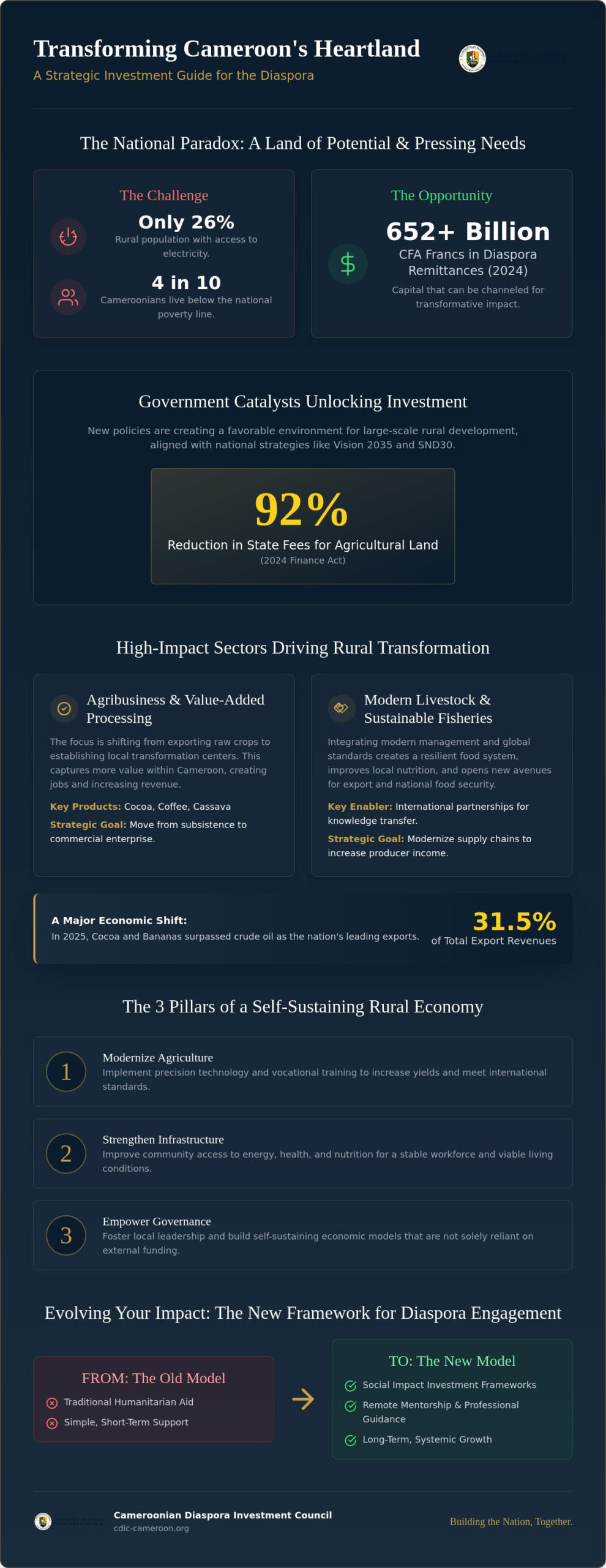
In 2024, remittances from the Cameroonian diaspora surpassed 652 billion CFA francs, yet only 26% of the rural population currently has access to electricity. It’s a stark contrast that highlights a significant opportunity for strategic intervention. You likely feel a deep sense of duty to contribute to your home’s growth, but the difficulty of finding vetted rural development projects Cameroon offers can be a major barrier. Without transparent investment channels or a direct connection to the specific needs of rural smallholders, even the most well-intentioned capital can fail to create long-term stability.
This article serves as your strategic roadmap for moving beyond simple support toward transformative leadership. You’ll discover how the latest 2026 land tenure regulations and the massive 92% reduction in agricultural state fees are opening new doors for sustainable development. We will outline the most promising sectors for high social and economic ROI; providing you with a structured methodology to identify, vet, and support the community-led initiatives that are reshaping the rural landscape. By the end of this guide, you’ll understand exactly how to leverage professionalized frameworks to drive measurable, systemic progress across the nation.
Key Takeaways
- Understand how rural development aligns with Cameroon’s Vision 2035 to ensure your contributions foster national economic stability.
- Identify high-impact rural development projects Cameroon offers in the agricultural and livestock sectors, focusing on value-added processing rather than subsistence.
- Transition your support from traditional humanitarian aid toward a social impact investment framework designed for long-term systemic growth.
- Learn how to provide remote mentorship and professional guidance to rural cooperatives, effectively bridging the gap between global expertise and local potential.
- Access the CDIC Investor Portal to discover a curated selection of vetted initiatives, ensuring your engagement is transparent and professionally managed.
Understanding the Landscape of Rural Development in Cameroon
The transformation of rural Cameroon is far more than a humanitarian mission; it’s a strategic pillar of national stability and economic sovereignty. Under the framework of Vision 2035 and the National Development Strategy (SND30), rural development is defined as the structural modernization of the “Heartland.” This region serves as the backbone of the country’s economy, yet it faces a stark reality. While rural areas drive the agricultural sector, the rural electrification rate stood at just 26% in 2023. Approximately 4 in 10 Cameroonians live below the national poverty line, a statistic that underscores the urgent need for professionalized rural development projects Cameroon can rely on for long-term growth.
The historical trajectory of Spatial Development in Cameroon has often prioritized urban centers, creating a disconnect between the capital-rich cities and the resource-rich countryside. This imbalance is compounded by climate change and a reliance on traditional farming methods that limit productivity. To achieve the goals set for 2030 and beyond, the nation is transitioning from subsistence living to a model of commercial rural enterprise. This shift is supported by recent policy changes, such as the 2024 Finance Act, which reduced state royalties for agricultural land by 92% to encourage large-scale investment and local processing.
The Core Objectives of Rural Transformation
Successful rural evolution requires a methodical approach that moves beyond temporary aid. The current strategy focuses on three primary pillars:
- Modernizing Agriculture: Implementing precision technology and vocational training to increase yields and meet international certification standards.
- Strengthening Infrastructure: Improving community health, nutrition, and energy access to ensure a stable workforce and viable living conditions.
- Empowering Governance: Fostering local leadership and self-sustaining economic models that don’t rely solely on external funding.
Why Rural Growth Matters for the Global Diaspora
For the diaspora, the rural landscape represents the most significant opportunity for high-impact social investment. Rural areas are the primary source of the nation’s food security and its most promising export revenues. In 2025, cocoa and bananas surpassed crude oil as the leading export products, proving that the “Heartland” is the true engine of national wealth. By engaging with rural development projects Cameroon currently offers, the global community can bridge the urban-rural divide. This involvement ensures ancestral regions aren’t left behind while creating a more resilient and balanced national economy for future generations.
Key Sectors Driving Rural Transformation in Cameroon
Economic growth in the Cameroonian “Heartland” is no longer restricted to traditional farming. Today, a multi-sectoral approach is redefining how rural development projects Cameroon operates, moving from simple extraction to sophisticated production. While agriculture remains the foundation, the integration of modern livestock management and sustainable fisheries is creating a more resilient food system. These sectors are the primary engines of national wealth. In 2025, cocoa and bananas became the nation’s leading export products, accounting for 31.5% of export revenues. This shift proves that rural areas are capable of driving global trade when supported by the right infrastructure and investment frameworks.
To sustain this momentum, international partnerships are playing a critical role in knowledge transfer. Programs like the GIZ rural development program demonstrate the efficacy of combining local expertise with global standards for livestock and pasture resources. By modernizing supply chains, rural producers can finally capture a larger share of the value chain, ensuring that the wealth generated in the fields stays within the communities that labor there. This professionalization is attracting a new wave of interest from the diaspora, who see the potential for both economic returns and social impact.
Agribusiness and Value-Added Processing
The era of exporting raw, unprocessed crops is coming to an end. The current focus is on establishing local transformation centers that convert raw cocoa, coffee, and cassava into finished or semi-finished goods. This transition is supported by Ordinance No 2025/002, which provides significant investment incentives for enterprises that prioritize local processing. By supporting smallholders with modern irrigation and sustainable soil management, these projects ensure a consistent supply of high-quality raw materials. Connecting these rural hubs to urban and international markets transforms a village into a commercial center, creating jobs and reducing the need for urban migration.
Rural Electrification and Digital Connectivity
Energy is the essential catalyst for industrial growth. With the rural electrification rate at 26% as of 2023, the government is aggressively promoting solar mini-grids to bridge the gap. These decentralized energy solutions are transformative; they enable cold storage for perishable goods and allow for night-time vocational training. Parallel to this, digital connectivity is revolutionizing rural finance. Mobile banking and digital tools for market price transparency allow farmers to bypass predatory middlemen. Finding vetted opportunities in these high-growth sectors is the first step toward meaningful impact, and registering for the Investor Portal provides the necessary transparency to move forward with confidence.
Education and Skills for Rural Entrepreneurship
Infrastructure alone cannot drive progress. It requires a skilled workforce capable of managing modern enterprises. Current initiatives are focusing on training the next generation of rural entrepreneurs in financial literacy, sustainable land management, and digital marketing. By equipping local youth with these specialized skills, we ensure that rural development projects Cameroon initiates are self-sustaining. This human capital investment is the final piece of the puzzle, turning rural regions into vibrant hubs of innovation and economic stability.
From Aid to Strategic Investment: A New Framework
Traditional humanitarian aid often serves as a necessary stopgap during crises, yet it rarely addresses the structural deficiencies that hinder long-term prosperity. To achieve the ambitious targets of the National Development Strategy (SND30), the focus must shift from temporary relief to social impact investing. This transition requires a move away from the “aid dependency” model toward a framework of strategic capital mobilization. While foundational initiatives like the World Bank Rural Development Fund Project have historically focused on large-scale institutional building and water supply, the next phase of growth depends on the agility of private and diaspora-led capital. By viewing rural development projects Cameroon hosts as investment opportunities rather than charity cases, we can foster a culture of accountability and economic resilience.
The rise of social impact investing allows the global community to target specific outcomes, such as improved crop yields or expanded energy access, while expecting a measurable return on community well-being. This model prioritizes sustainability. It ensures that projects are not just launched but are maintained through local revenue generation and professional management. Ordinance No 2025/002, signed in July 2025, provides the legal clarity needed for these investments, establishing new rules and incentives that apply to national and diaspora investors alike. This legislative stability is the cornerstone of a mature investment ecosystem.
The Role of the Diaspora in Resource Mobilization
Remittances from the Cameroonian diaspora exceeded 652 billion CFA francs in 2024. These funds are a testament to the community’s commitment, but their impact is often fragmented across individual households. The challenge lies in moving from these isolated transfers to collective investment pools that can fund significant rural development projects Cameroon needs for industrialization. By aggregating resources, the diaspora can tackle large-scale technical challenges that individual efforts cannot reach. For those looking to balance philanthropic goals with strategic growth, our guide on humanitarian projects in Cameroon provides a comprehensive look at how to align immediate needs with long-term systemic progress.
Building Sustainable Community Initiatives
True transformation is only possible when local communities have a seat at the table. Local ownership ensures that initiatives are tailored to the specific ecological and cultural context of the region. Measuring the success of these projects requires a sophisticated look at Social Return on Investment (ROI), tracking improvements in local governance, economic resilience, and specialized skills. Since 2021, the Ministry of External Relations has mobilized approximately 10 billion FCFA through its diaspora programs, supporting over 500 entrepreneurs. These figures prove that when the diaspora provides both capital and professional guidance, rural cooperatives can evolve into self-sustaining enterprises that anchor the national economy.
How to Support Rural Entrepreneurship and Infrastructure
Supporting rural growth requires a shift from passive observation to active facilitation. Identifying high-potential rural startups and cooperatives is the first step in creating a resilient economic ecosystem. These entities often possess deep local knowledge but lack the capital or technical expertise to scale. By focusing on rural development projects Cameroon currently prioritizes, diaspora members can act as sophisticated facilitators of growth. This isn’t just about funding. It’s about advocating for rural interests in national development forums to ensure the “Heartland” remains a priority in the 2026 fiscal cycle.
The 2024 Finance Act, which reduced state royalties for rural plots to just 2 FCFA per square meter, has created a unique window for infrastructure development. This legislative shift makes it far more viable for the diaspora to invest in tangible assets that anchor rural communities. To explore how professional expertise in construction and land management can enhance the quality of such projects, check out Green Earth, LC. By aligning your resources with these incentives, you’re not just building structures; you’re securing the future of national food security and export potential.
Mentorship and Skills Transfer
Investing in “Last Mile” infrastructure addresses the critical gaps that lead to economic leakage. Financing small-scale warehouses is essential to reduce post-harvest loss, which remains a significant hurdle for smallholders. With the new 2026 ministerial circular authorizing traditional chiefs to issue “Attestations of Recognition of Customary Land Rights,” securing land for these facilities has become more transparent and accessible. Improving rural-to-market roads through community-funded initiatives ensures that produce reaches urban centers while still fresh, maximizing the return for local producers.
Supporting clean water initiatives serves as the foundation for both economic health and community stability. These projects provide the necessary environment for businesses to thrive and for families to remain in their ancestral regions. To start your journey as a strategic partner in these initiatives, you can register for the Service Provider Portal to connect your expertise with verified rural development projects Cameroon offers on the ground.
Partnering with CDIC for Sustainable Rural Progress
The transition from vision to execution requires a partner that understands the intricate complexities of the local landscape while maintaining global standards of integrity. As the essential bridge between the global diaspora and the Cameroonian heartland, CDIC provides the professional framework necessary to navigate the challenges of rural investment. We don’t just identify opportunities; we curate a portfolio of rural development projects Cameroon needs for systemic growth, ensuring each initiative is vetted for transparency, local ownership, and long-term viability. By aligning with our mission, you’re moving beyond fragmented support toward a model of organized, high-impact leadership.
Our vetting process is rigorous, drawing on the latest regulatory changes such as the July 2025 Investment Ordinance and the 2026 land tenure reforms. This methodical approach ensures that every project hosted on our platforms has a clear path to success, supported by the legal and social structures required for sustainable operation. Whether you’re interested in agribusiness, renewable energy, or infrastructure, our specialized portals serve as the definitive link between your capital and local potential. We provide the strategic intelligence needed to ensure your engagement creates lasting value for both the investor and the community.
The CDIC Membership Advantage
Joining CDIC grants you access to a sophisticated network of professionals, investors, and community leaders who share a unified vision for national progress. Membership isn’t a passive status; it’s an invitation to engage with a curated list of community development projects that have been rigorously screened for social ROI. You’ll have the opportunity to network with other diaspora experts, fostering collaborations that solve technical hurdles in ancestral regions. For those ready to formalize their commitment, our Cameroon diaspora membership guide provides a detailed breakdown of how to leverage these institutional resources for maximum impact.
Getting Started: Your Path to Impact
Your journey toward driving rural transformation begins with a few structured steps. Registering on the Investor Portal or the Service Provider Portal allows you to match your resources or expertise with specific, high-priority rural development projects Cameroon is currently implementing. This digital infrastructure provides the transparency you need to invest with confidence, knowing that your contributions are being managed through professional channels. It’s about building a stable foundation for the next generation of rural entrepreneurs.
Beyond capital, we encourage you to connect with CDIC Ambassadors in your region. These leaders represent our global network of advocates, providing localized guidance and collective strength to our initiatives. By participating in the CDIC Ambassadors Program, you aren’t just supporting a project; you’re contributing to a legacy of sustainable growth in the heartland. Together, we can ensure that the 652 billion CFA francs in annual remittances are leveraged not just for individual needs, but for the collective prosperity of our nation.
Architecting a Resilient Future for the Heartland
The evolution of rural Cameroon from a site of subsistence to a hub of industrial potential is a shared responsibility that demands strategic precision. By leveraging 2026 land reforms and the significant reduction in agricultural fees, the diaspora can transform individual remittances into collective engines of progress. You’ve seen how sectors like value-added agribusiness and solar mini-grids are ready for scale. The path forward requires moving beyond temporary aid toward the professionalized rural development projects Cameroon needs for systemic stability.
Realizing this vision requires the support of a trusted institutional facilitator. CDIC offers the transparency and expertise needed to bridge the gap between global ambition and local impact. Through vetted project matching in our Investor Portal and the guidance of our global network of professional Ambassadors, we ensure your contributions drive sustainable, mission-driven growth. We invite you to Become a CDIC Member and Lead Rural Transformation today. Your leadership is the essential link in building a legacy of excellence for the nation.
Frequently Asked Questions
What are the most successful types of rural development projects in Cameroon?
Successful initiatives typically focus on value-added agribusiness and decentralized energy solutions. Projects that transition from raw crop exports to local transformation centers have shown the highest resilience and economic impact. These rural development projects Cameroon prioritizes often combine modern irrigation with sustainable soil management to ensure consistent yields and meet international certification standards.
How can the diaspora ensure their investments in rural areas are safe?
Safety is ensured through institutional transparency and adherence to recent legal reforms. Investors should leverage the 2026 ministerial circular on customary land rights to secure property interests through official attestations. Utilizing a professional project matching framework, such as the CDIC Investor Portal, provides an additional layer of due diligence and local stakeholder verification to mitigate risk.
What role does agriculture play in Cameroon’s rural development?
Agriculture serves as the primary engine for rural economic sovereignty and national export revenue. In 2025, cocoa and bananas became the leading exports, surpassing crude oil revenues for the first time. It provides the essential foundation for national food security and remains the primary livelihood for the four in ten Cameroonians currently living below the poverty line.
Are there tax incentives for investing in rural projects in Cameroon?
Significant incentives exist under the 2024 Finance Act and Ordinance No 2025/002. Specifically, state royalties for rural agricultural plots were reduced by 92%, dropping from 25 FCFA to just 2 FCFA per square meter. These measures are designed to lower the barrier for diaspora members looking to establish commercial enterprises in ancestral regions.
How does rural electrification impact development in remote regions?
Electrification transforms remote regions into viable industrial hubs by enabling cold storage and night-time vocational training. While current access is limited to 26% of the rural population, the introduction of solar mini-grids provides the power necessary for small-scale processing. This energy access is the critical link required to move from subsistence farming to sophisticated commercial production.
Can I support rural projects without a large financial investment?
Meaningful impact is possible through the strategic transfer of global expertise and professional mentorship. Professionals can guide local cooperatives through international market standards or business development using digital networking tools. Joining the CDIC Ambassadors Program allows individuals to lead transformation through advocacy and professional facilitation without requiring significant upfront capital.
How does CDIC vet the rural projects listed on its portal?
CDIC employs a comprehensive vetting methodology focused on transparency, sustainability, and local ownership. Each project is evaluated for its alignment with National Development Strategy (SND30) goals and its capacity for long-term revenue generation. This process ensures that rural development projects Cameroon offers to investors have undergone thorough financial and operational due diligence.
What is the difference between humanitarian aid and rural development investment?
Humanitarian aid provides immediate relief for crises, while rural development investment focuses on long-term structural evolution. Investment targets the creation of self-sustaining economic models and local wealth generation rather than temporary stopgap measures. It prioritizes a measurable social return on investment (ROI) through improved infrastructure, education, and commercial resilience.