Did you know that Cameroon’s agricultural market value has scaled to an estimated 10.65 billion dollars in 2026? This valuation reflects a nation transitioning from basic production to a sophisticated industrial powerhouse. For the diaspora, identifying the right agribusiness investment opportunities Cameroon 2026 presents is no longer just about land ownership; it’s about mastering the value chain. You likely feel a duty to reinvest in your heritage, yet you’re understandably cautious about the risks of informal management or opaque regulatory shifts.
We believe that institutional transparency is the only way to turn your ambition into a sustainable reality. This article provides a strategic roadmap to the most lucrative sectors, from import substitution in maize to high-value cocoa processing. You’ll learn how to leverage the latest fiscal incentives, such as the 92% reduction in agricultural land royalties, while connecting with professional frameworks that protect your capital. We’ll examine the 2026 regulatory landscape and introduce the vetted pathways that bridge the gap between global vision and local execution.
Key Takeaways
- Understand why 2026 marks a pivotal transition from primary farming to high-value industrial processing within Cameroon’s emerging economy.
- Identify the most lucrative agribusiness investment opportunities Cameroon 2026 offers, specifically focusing on value-added cocoa processing and the animal protein supply chain.
- Learn to prioritize scalable value chains over subsistence-style projects by applying a rigorous commercial framework to your investment strategy.
- Discover how to safeguard your capital through multi-stage funding releases and institutional oversight rather than relying on informal, family-managed arrangements.
- Explore how the CDIC Investor Portal serves as a strategic bridge, connecting diaspora capital with vetted, high-potential agricultural projects through professional membership tiers.
The Agribusiness Landscape in Cameroon: Why 2026 is a Strategic Turning Point
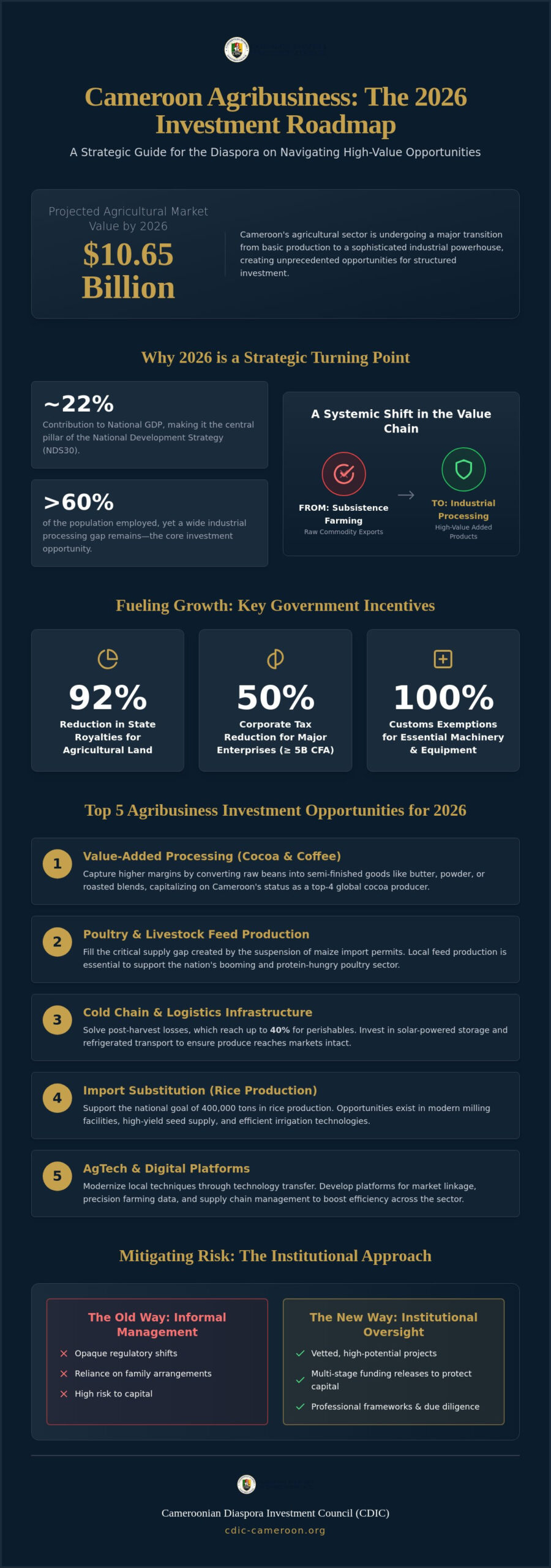
The year 2026 represents a defining moment for Cameroon’s economic trajectory. Agribusiness has emerged as the central pillar of the National Development Strategy (NDS30), contributing approximately 22% to the national GDP. We’re witnessing a systemic shift where traditional subsistence farming is being replaced by high-value industrial processing. This transition is fueled by a growing demand for food security and a national drive toward import substitution. For investors, the agribusiness investment opportunities Cameroon 2026 offers are rooted in this structural modernization. It’s a move away from the uncertainty of the past toward a future defined by scale and efficiency.
The maturation of the African Continental Free Trade Area (AfCFTA) has fundamentally altered the risk-to-reward ratio for local production. Cameroon is no longer just a domestic market; it’s a strategic export hub for the CEMAC region and the wider continent. By focusing on value-chain integration, early-mover institutional investors can capture margins that were previously lost to raw commodity exports. The current landscape of Agriculture in Cameroon shows that while the sector employs over 60% of the population, the industrial processing gap remains wide. 2026 is the “sweet spot” where infrastructure, regional trade policy, and local demand finally align with global capital.
Government Incentives and the 2026 Investment Code
The 2026 Investment Code provides a robust framework for capital protection and growth. Under the latest Finance Law, the government has intensified fiscal support to attract professional operators. Agricultural enterprises now benefit from a staggering 92% reduction in state royalties for land. For instance, rural plots that once carried higher fees are now accessible at just 2 FCFA per square meter. Major enterprises investing at least 5 billion CFA Francs are eligible for a 50% reduction in corporate tax during their operational phase. These incentives, combined with customs exemptions for essential machinery, create a fertile environment for diaspora-led corporations to establish industrial-scale operations with significantly lower overhead.
The Role of the Global Diaspora as a Development Catalyst
The global diaspora is the missing link in this industrial evolution. Moving beyond simple remittances, there’s a growing trend toward structured Cameroon diaspora membership to pool resources and professional expertise. Diaspora-led projects are uniquely positioned to modernize local techniques through technology transfer and the implementation of international market standards. You aren’t just providing capital. You’re acting as a sophisticated bridge that ensures Cameroonian produce meets the quality benchmarks required for global competition. This institutional approach transforms individual efforts into a collective engine for systemic growth, ensuring that your investment serves both your portfolio and your heritage.
Top 5 Agribusiness Investment Opportunities in Cameroon for 2026
The agribusiness investment opportunities Cameroon 2026 presents are defined by a move toward vertical integration. We’re no longer looking at simple cultivation; the real value lies in the “middle” of the supply chain. As the nation targets a rice production goal of 400,000 tons and continues to lead as the world’s fourth-largest cocoa producer, the demand for industrial capacity is skyrocketing. For the diaspora, this means shifting focus from owning hectares to owning the systems that process, preserve, and distribute what those hectares produce.
- Value-Added Processing: Converting raw cocoa and coffee into semi-finished goods like butter, powder, or roasted beans captures significantly higher margins than bulk export.
- Poultry and Livestock Feed: With the suspension of maize import permits as of May 2026, there’s a critical opening for local feed production to support the booming poultry sector.
- Cold Chain Logistics: Post-harvest losses currently reach 40% for many perishable crops. Investors can solve this through solar-powered storage and refrigerated transport.
- AgTech and Digital Marketplaces: Creating mobile platforms that bypass traditional middlemen to connect rural farmers directly with urban wholesalers.
- Sustainable Forestry and NTFPs: Exporting high-value non-timber products like Penja pepper or Oku honey, which benefit from protected geographic indications.
While the Cameroon Investment Climate reports acknowledge certain bureaucratic complexities, the 2026 fiscal framework provides clear pathways for those using institutional channels. Success in this environment requires a departure from informal “family-managed” projects toward professional investor portal registration where projects are vetted and monitored.
Industrial Processing: The Golden Opportunity
The rise of local consumption is driving a need for domestic chocolate and coffee brands. Beyond the “Made in Cameroon” pride, there’s a practical economic advantage in processing cashews and tropical fruits for the European organic market. Small-to-medium scale processing units require relatively modest capital compared to heavy industry but offer rapid scalability. By focusing on semi-finished goods, you avoid the volatility of raw commodity prices while benefiting from export duty exemptions on processed agricultural products.
Infrastructure and Logistics: The Missing Link
Investing in the Douala-Yaoundé corridor’s distribution network is perhaps the most stable entry point. Solar-powered cold storage units allow vegetable farmers to wait for optimal market prices rather than selling at a loss due to impending spoilage. Strategic trucking fleets and “last-mile” delivery solutions for improved seeds and fertilizers are essential for the 6-7% annual growth projected in maize production. These infrastructure plays offer consistent service-based revenue that is less dependent on weather cycles than direct farming.
Evaluating Farming Investments: A Commercial Framework for the Diaspora
Identifying agribusiness investment opportunities Cameroon 2026 is the first step; evaluating them through a commercial lens is what ensures longevity. Many diaspora investors fall into the trap of “vanity production.” These are projects fueled by nostalgia or a desire for land ownership rather than market data. To succeed in 2026, you must prioritize scalable value chains. This involves moving beyond the traditional “farm” concept and viewing your investment as a modern industrial entity. Our “Vision-to-Execution” logic requires that you align your business plan with the actualities of local infrastructure and regional trade demands.
A professional approach also means balancing your financial ROI with tangible community development. The most successful projects in the current Cameroon investment climate are those that create shared value. By integrating local smallholders into your supply chain, you build a protective social buffer around your assets while securing a consistent raw material supply. Choosing the right legal structure is equally critical. While individual ownership might seem simpler, corporate structures offer superior tax benefits under the 2026 Investment Code and facilitate easier capital repatriation when your project reaches maturity.
Assessing Local Management and Human Capital
Professional management is non-negotiable. The era of the “family-managed” project is over; it’s the most common path to capital depletion for those abroad. In 2026, you need on-the-ground project developers who are held to rigorous, data-driven KPIs. This institutional approach ensures that your vision is executed with precision regardless of your physical location. Sustainability also depends on your local workforce. By investing in training programs that modernize farming techniques, you create a skilled labor pool that’s personally invested in the project’s success. It’s about building a team, not just hiring hands.
Navigating Land Tenure and Legal Compliance
Land tenure is often the most significant hurdle for the diaspora. You must navigate the space between customary rights and statutory law with extreme care. Verbal agreements or traditional handshakes don’t protect your investment in the long term. You need formal, state-recognized documentation, such as a land title or a long-term lease. Don’t attempt to navigate this alone. Partnering with verified legal experts through the CDIC Service Provider Portal provides the security you need. These professionals ensure that your land acquisition is compliant with all local regulations, protecting your heritage and your capital from future disputes.
Mitigating Risk: Ensuring Transparency and Due Diligence from Abroad
Investing in your home country from thousands of miles away requires a fundamental shift in mindset. Trust is a sentiment, but verification is a strategy. When exploring agribusiness investment opportunities Cameroon 2026, your primary defense against capital depletion isn’t just a good business plan; it’s a rigorous due diligence framework. We’ve seen too many projects fail because of “informal oversight” where family ties were prioritized over professional accountability. In 2026, the standard for diaspora investment has evolved to require institutional-grade transparency.
One of the most effective ways to safeguard your capital is through multi-stage funding releases. Instead of deploying your entire investment upfront, structure your capital injections around verifiable project milestones. For instance, funds for a poultry processing unit should only be released once the foundation is poured and the equipment import licenses are confirmed. To bridge the physical gap, modern investors are increasingly utilizing satellite monitoring and third-party auditing to track farm progress in real time. This technical layer of oversight provides objective data that supplements the reports you receive from your local team.
The CDIC Ambassadors Program plays a pivotal role in this ecosystem of trust. These are professionals on the ground who provide local oversight and ensure that project developers are adhering to the agreed-upon roadmap. They act as your eyes and ears, providing a level of localized intelligence that no digital dashboard can fully replace. By moving away from isolated, individual ventures toward a structured institutional framework, you significantly lower your risk profile while increasing your potential for sustainable growth.
Identifying Red Flags in Agricultural Projects
Be wary of “guaranteed” high returns. Agribusiness is subject to biological cycles and market fluctuations; anyone promising immediate, massive ROI is likely masking a lack of operational depth. Inflated yields and unrealistic land acquisition costs are common warning signs of a poorly researched project. If a developer cannot produce clear accounting records or a formal governance structure, it’s a signal that your capital will be managed with the same lack of discipline. Professionalism in 2026 is measured by the quality of a project’s data, not the height of its promises.
The CDIC Framework for Professional Due Diligence
The most secure way to enter the market is by using the Investor Portal Registration to access pre-vetted project developers. This portal filters out the noise, presenting you with opportunities that have already undergone a baseline level of institutional scrutiny. Furthermore, you can leverage our Service Provider Portal to hire independent auditors and legal experts who specialize in agricultural compliance. Collaborating with fellow diaspora members through these platforms allows you to pool intelligence and risk, transforming a solitary investment into a collective movement for national development.
Navigating Your Investment Journey via the CDIC Platform
The transition from identifying agribusiness investment opportunities Cameroon 2026 to executing a successful project requires a sophisticated institutional partner. CDIC serves as that essential bridge, replacing the uncertainty of informal ventures with a structured framework of data and professional connections. By moving away from isolated efforts, you’re joining a collective of visionaries dedicated to Cameroon’s industrial evolution. It’s about turning global capital into local impact through a system designed for transparency, accountability, and sustainable growth.
Access to this ecosystem is facilitated through tiered membership levels tailored to your specific goals. Whether you opt for an Individual Membership or a Corporate Membership, you gain entry to a curated environment of investment intelligence; you can also explore The Jembe Platform Subscription to access specialized cultural intelligence and consumer data. These levels are designed to provide the tools and oversight necessary for your specific scale of ambition. Our mission is to ensure that every diaspora member has the resources to participate in the nation’s growth with the confidence of an institutional investor. We provide the methodology; you provide the vision.
Registering for the Investor and Service Provider Portals
Your journey begins with Investor Portal Registration, the primary gateway for matching your capital with vetted local projects. This platform allows you to filter agribusiness investment opportunities Cameroon 2026 based on your risk appetite and sector interest, from industrial cocoa processing to maize feed production. Simultaneously, the Service Provider Portal connects you with the essential human capital required for execution. Through this portal, you can find vetted lawyers, accountants, and agronomists who understand both local regulations and international standards. This dual-portal system ensures that your project is supported by a professional team from the moment of inception.
The CDIC Ambassadors Program: Local Eyes for Global Investors
The CDIC Ambassadors Program provides the localized oversight that remote investors often lack. These Ambassadors are seasoned professionals who facilitate on-the-ground project monitoring and maintain vital links with local authorities. Their presence ensures that your project remains on track and compliant with the 2026 Investment Code. They represent a global network with deep local roots, opening doors that are often closed to individual investors. By leveraging this network, you gain a level of project security that traditional “family-managed” models cannot match. Join CDIC today to secure your agribusiness future and become a proactive catalyst for Cameroon’s emerging economy.
Securing Your Legacy in Cameroon’s Industrial Future
The evolution of Cameroon’s agricultural sector is no longer a prospect; it’s a present reality. By focusing on industrial value chains and leveraging historic fiscal incentives, you can transform your capital into a driver of national development. Success in this new era requires moving beyond the risks of informal oversight toward a professionalized, data-driven approach. Navigating the diverse agribusiness investment opportunities Cameroon 2026 presents is a task that demands strategic intelligence and credible local partnerships.
To ensure transparency and operational excellence, you need an institutional bridge that connects global ambition with local execution. We invite you to register for the CDIC Investor Portal and discover vetted opportunities that align with your strategic goals. Our platform offers professional tiered membership options, access to a global network of CDIC Ambassadors for on-the-ground oversight, and a vetted Service Provider directory for essential legal and financial support. Your heritage is the foundation; our framework is the bridge. Together, we’ll realize the full potential of Cameroon’s soil while building a sustainable legacy for the future.
Frequently Asked Questions
Is agribusiness in Cameroon safe for diaspora investors in 2026?
Agribusiness is safe when conducted through professional institutional channels rather than informal family arrangements. By utilizing structured due diligence and milestone-based funding, investors can mitigate traditional risks. The 2026 regulatory environment has matured to favor those who prioritize transparency and legal compliance over traditional handshakes.
How much capital is needed to start an agribusiness investment in Cameroon?
Capital requirements vary significantly based on the scale and nature of the project. Small-to-medium processing units require different investment levels compared to large-scale industrial plantations. We recommend matching your capital to your specific risk appetite through the Investor Portal, where diverse agribusiness investment opportunities Cameroon 2026 are listed across various financial entry points.
What are the most profitable crops to grow in Cameroon for export?
Cocoa and coffee remain high-value exports, but the real profitability lies in value-added processing. Products with geographic indications, such as Penja pepper and Oku honey, command premium prices on the global market. Additionally, tropical fruits and cashews processed for European organic markets offer high margins for those moving beyond raw commodity sales.
Can foreigners or non-resident Cameroonians own agricultural land?
Foreigners and non-resident Cameroonians can secure agricultural land through long-term leases or by forming local corporate entities. The 2026 legal framework facilitates land access for diaspora-led corporations through designated industrial zones. It’s essential to secure statutory land titles rather than relying on customary rights to ensure long-term asset protection.
How does CDIC vet the projects listed on the Investor Portal?
CDIC employs a rigorous verification process for all project developers before listing them on the Investor Portal. We review business models, legal compliance, and on-the-ground feasibility to ensure projects meet institutional standards. This vetting process provides a baseline of security, allowing investors to focus on strategic alignment rather than fundamental fraud detection.
What tax incentives are available for agricultural investments in 2026?
The 2026 Investment Code offers substantial tax holidays and customs exemptions for agricultural machinery. Major enterprises investing over 5 billion CFA Francs can receive a 50% reduction in corporate income tax. Additionally, the 2024 Finance Law reduced state royalties for agricultural land by 92%, significantly lowering the cost of entry for large-scale operations.
What happens if a project developer fails to meet their milestones?
Our milestone-based funding model ensures that capital is only released when specific project goals are achieved. If a developer fails to meet these benchmarks, further funding is suspended to protect your remaining assets. The CDIC Ambassadors Program provides the local oversight needed to identify these issues early and facilitate corrective actions or project restructuring.
How can I monitor my investment from abroad without traveling to Cameroon?
You can monitor your investment through the CDIC Investor Portal and our global network of Ambassadors. These professionals act as your local eyes, providing regular reports and verified data on farm progress. This institutional oversight allows you to manage your agribusiness investment opportunities Cameroon 2026 with confidence, regardless of your physical location.