
What if the capital you send home could do more than sustain a household; what if it could build a nation? For many global citizens, diaspora involvement Cameroon vision 2035 has long felt like a distant aspiration rather than a tangible roadmap. You’ve likely experienced the frustration of opaque local projects or the lack of vetted channels to deploy your professional expertise. It’s a common sentiment that while your heart remains in Cameroon, the bridge to meaningful, transparent participation is often missing, leaving your potential untapped.
This article bridges that gap by detailing how you can transition from traditional remittances to strategic investments that align with the 2035 emerging economy goal. We’ll explore the current progress of the National Development Strategy 2020-2030 and show you how to navigate the new 2025 investment incentives. You’ll discover a structured methodology for providing services and capital through professional networks, ensuring your contribution is both secure and impactful. By understanding these frameworks, you move from being a distant donor to a strategic architect of Cameroon’s industrial future, connected with a community of like-minded patriots.
Key Takeaways
- Understand the structural phases of the National Development Strategy 2030, which serves as the fundamental engine for Cameroon’s journey toward an emerging economy.
- Identify high-growth sectors such as digital infrastructure and agribusiness where your professional skills can catalyze systemic modernization.
- Learn why it’s vital to shift from consumption-based remittances to production-oriented models through active diaspora involvement Cameroon vision 2035.
- Navigate the complexity of local markets by using the CDIC Investor Portal to access vetted projects and transparent matching services.
- Establish a formal connection to national policy frameworks by leveraging tiered membership options designed for global patriots and professional leaders.
Understanding Cameroon Vision 2035: The Path to Emergence
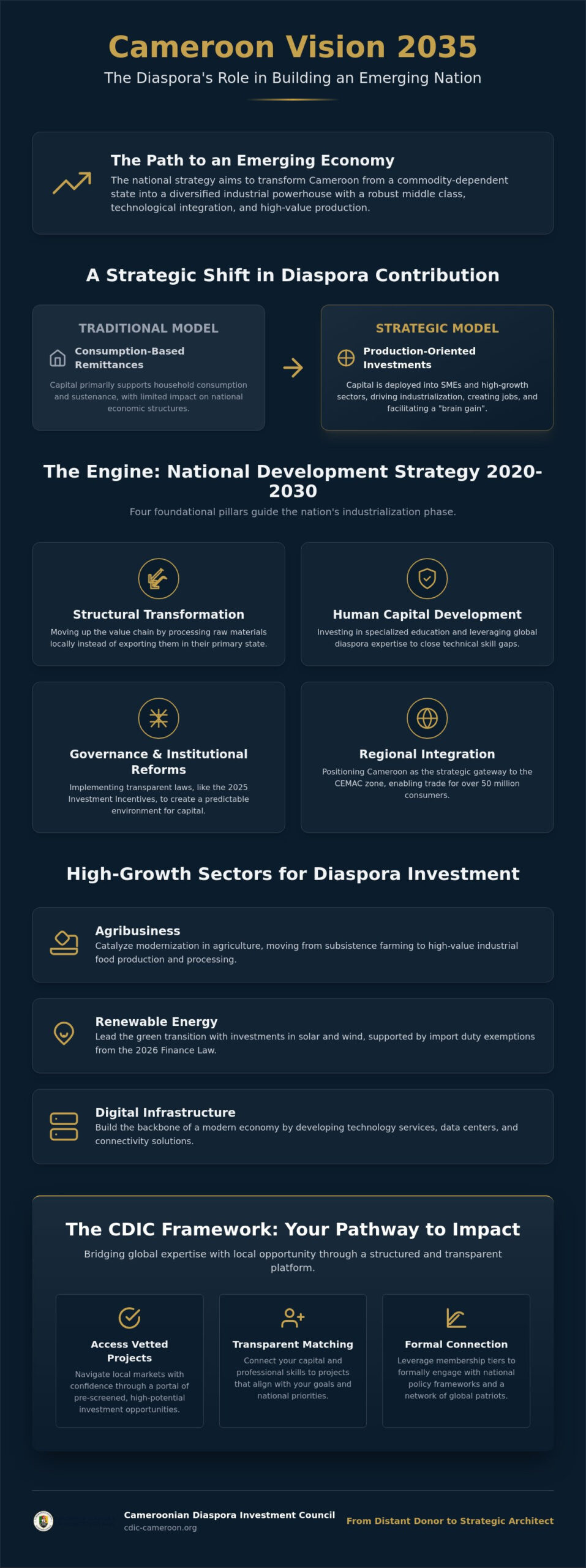
Cameroon’s journey toward an emerging economy is a deliberate, multi-decade strategy designed to transform the nation from a commodity-dependent state into a diversified industrial powerhouse. In this context, an “emerging economy” isn’t merely a statistical milestone. It represents a fundamental shift where the country achieves middle-income status, characterized by robust manufacturing, technological integration, and a resilient middle class. Understanding Cameroon’s economic landscape requires looking past traditional metrics to see the structural evolution currently underway. This transformation demands a move away from subsistence agriculture toward high-value industrial production, a transition that requires significant capital and technical sophistication.
The roadmap to 2035 is structured through four distinct phases. It began with a focus on poverty reduction and initial growth stabilization. It has now transitioned into an aggressive industrialization phase, anchored by the National Development Strategy 2020-2030 (NDS30). The subsequent stages involve consolidating these industrial gains and finally reaching full emerging status. Meeting the 2035 deadline is impossible through public spending alone. It requires a massive influx of private sector participation, where diaspora involvement Cameroon vision 2035 becomes the primary driver of sustainable progress.
The Four Pillars of the National Development Strategy
- Structural Transformation: Moving up the value chain by processing raw materials locally rather than exporting them in their primary state.
- Human Capital Development: Investing in specialized education and leveraging the global expertise of Cameroonians living abroad to close technical skill gaps.
- Governance and Institutional Reforms: Implementing laws like the 2025 Investment Incentives Ordinance to build a transparent, predictable environment for international capital.
- Regional Integration: Positioning Cameroon as the strategic gateway to the CEMAC zone, facilitating cross-border trade for over 50 million consumers.
Why the Diaspora is the Missing Link
While remittances have traditionally supported household consumption, the next decade requires a shift toward venture capital and direct investment in small-to-medium enterprises (SMEs). This isn’t just about the volume of capital; it’s about the quality of engagement. Strategic diaspora involvement Cameroon vision 2035 facilitates a “brain gain” effect, where global technical standards are reintroduced into local industries. This transfer of knowledge ensures that local manufacturing meets international quality benchmarks, making Cameroonian products competitive on the global stage. By aligning personal investment goals with these national pillars, global citizens provide the missing link between policy and execution. Vision 2035 is a collective mandate for all Cameroonians.
Strategic Pillars of Diaspora Involvement in National Growth
Realizing the industrial goals of 2035 requires more than policy; it demands the active deployment of global expertise into specific, high-growth sectors. Agribusiness, renewable energy, and digital infrastructure stand as the three most critical avenues for diaspora involvement Cameroon vision 2035. These sectors don’t just offer financial returns; they provide the structural foundation for the nation’s modernization. For instance, the 2026 Finance Law has extended import duty exemptions for solar and wind energy equipment for an additional 24 months, creating a prime window for diaspora investors to lead the green energy transition. This alignment with Cameroon’s Economic Emergence Action ensures that individual initiatives contribute directly to the national priority list, transforming fragmented efforts into a cohesive movement for growth.
Professional networks act as the connective tissue for these sectors. By facilitating international trade partnerships, the diaspora helps local manufacturers access global supply chains, ensuring that “Made in Cameroon” becomes a mark of excellence. This isn’t a passive process. It’s an active exchange of standards, certifications, and market intelligence. When global citizens leverage their professional standing in Europe, North America, or Asia, they don’t just bring money; they bring the credibility required to attract institutional partners to Cameroonian projects.
Industrialization and Technology Transfer
Modernizing local manufacturing depends heavily on the import of advanced machinery and sophisticated processes. The diaspora is uniquely positioned to facilitate this technology transfer, moving beyond simple trade to deep-rooted industrial partnerships. By using the Service Provider Portal, global experts can match their technical skills with local factories that require automation or specialized engineering. In Douala, for example, diaspora-led startups are currently revolutionizing the logistics sector by implementing blockchain-based tracking systems that reduce port delays. These technical interventions are essential for scaling local production to meet the demands of the wider CEMAC region. Exploring these opportunities is simplified for those who register through the professional portal to sync their expertise with local demand.
Humanitarian and Community Development
Sustainable growth isn’t limited to industrial zones; it must reach the community level to be truly inclusive. The next phase of engagement involves aligning philanthropic efforts with sustainable national infrastructure goals. This means moving from one-off donations to self-sustaining community projects, such as solar-powered water irrigation systems or rural health clinics integrated with telemedicine. CDIC Ambassadors play a vital role here, coordinating regional development and ensuring that community initiatives aren’t isolated, but rather integrated into the broader vision of national emergence. By focusing on projects that create local jobs and improve quality of life, the diaspora ensures that the road to 2035 is paved with collective prosperity.
Beyond Remittances: Transitioning to Strategic Investment Models
While remittances remain a vital lifeline for millions of households, their role in national development is often limited to immediate consumption. To achieve the ambitious milestones set out in Cameroon Vision 2035, the diaspora must pivot toward production-based investment models. This transition isn’t just about changing where the money goes; it’s about changing the fundamental nature of the transaction. By shifting from a “donor” mindset to a “stakeholder” perspective, global citizens can participate in the value creation that defines an emerging economy.
The “Multiplier Effect” of investing in local small-to-medium enterprises (SMEs) far outweighs the impact of direct cash transfers. When capital is injected into a manufacturing startup or a processing plant, it funds the acquisition of machinery, creates sustainable jobs, and contributes to the local tax base. These investments build the very infrastructure that reduces the future need for emergency remittances. By pooling resources through collective investment vehicles or exploring Diaspora Bonds, individuals can participate in large-scale projects that drive systemic resilience. This strategic diaspora involvement Cameroon vision 2035 transforms capital into a permanent engine of growth.
To complement these local efforts, many professionals utilize fintech apps to explore Buy & Sell Gold and other digital assets, ensuring their global wealth is managed efficiently while they contribute to the nation’s emergence.
Remittances vs. Strategic Equity: A Comparison
The psychological shift from providing relief to building wealth is the cornerstone of professional engagement. Understanding the difference in long-term outcomes is essential for any patriot looking to make a lasting impact. Consider these key differences in methodology and impact:
- Primary Goal: Consumption remittances focus on short-term household relief, whereas strategic equity targets long-term industrial growth and asset appreciation.
- Economic Impact: Remittances are immediate and localized; strategic investments compound through job creation and the modernization of supply chains.
- Diaspora Identity: The individual moves from the role of a benevolent donor to that of a strategic stakeholder with a seat at the table.
- Risk Management: While traditional transfers rely on family trust, strategic investments are secured through professional institutional vetting and legal frameworks.
Professional vetting bodies like CDIC provide the necessary risk mitigation, ensuring that your transition into equity investment is supported by data and clear legal safeguards.
Due Diligence and Transparency in 2026
The most frequent objection to local investment is the perceived lack of transparency. However, as of July 2026, Cameroon’s business environment has seen significant reforms, including the 2025 Investment Incentives Ordinance and the digitalization of administrative procedures for the diaspora. The CDIC Investor Portal addresses these concerns directly by offering a curated selection of opportunities that meet international standards for accountability. Every project on the portal undergoes a rigorous viability check, providing you with the clarity needed to commit capital with confidence. Institutional vetting is the essential safeguard that allows diaspora involvement Cameroon vision 2035 to move from the sidelines into the heart of national development.
Practical Pathways for Diaspora Engagement and Project Development
Transitioning from theory to action requires a reliable interface that mitigates the inherent risks of cross-border investment. For many, the primary hurdle isn’t a lack of desire, but a lack of a clear, professional entry point. The CDIC framework provides this structured gateway, ensuring that diaspora involvement Cameroon vision 2035 is both methodical and impactful. By moving beyond informal channels, you align your capital and skills with a system designed for institutional-grade accountability and strategic growth.
Scaling your impact often requires moving from individual projects to broader collective alliances. Corporate Membership options allow established diaspora-led businesses to pool resources and tackle larger infrastructure or industrial projects. This collaborative approach ensures that diaspora involvement Cameroon vision 2035 reaches the scale necessary for true structural change. You can begin this journey today by choosing the membership tier that fits your professional profile and long-term objectives.
The CDIC Investor and Service Provider Portals
Accessing the database of sustainable initiatives begins with a secure registration process on the CDIC portals. These platforms serve as a digital clearinghouse where capital meets vetted project developers. Unlike general investment boards, the matching process here is guided by the strategic priorities of the National Development Strategy 2030. If you possess specialized technical skills, the Service Provider Portal allows you to consult on national-scale projects, ensuring that global standards are integrated into local execution. This monitoring framework doesn’t just launch projects; it tracks their progress to ensure long-term viability and transparency.
The CDIC Ambassadors Program: Global Leadership
For those ready to assume a role of professional leadership, the CDIC Ambassadors Program offers a platform to represent Cameroon’s economic interests in host countries. Ambassadors act as focal points, organizing local business forums to mobilize regional resources and expertise. This isn’t merely networking; it’s a high-level strategic function. You become the essential link in economic transformation discussions, representing the collective ambition of the global diaspora to international partners and institutional investors. For a deeper understanding of how these forums translate into concrete investment opportunities, the Cameroon diaspora business forum strategic guide outlines the specific frameworks and incentives available to engaged professionals. By taking on this mantle, you help bridge the gap between global potential and local realization.
To take the first step in this structured roadmap, you can register for the CDIC Investor Portal and connect with vetted opportunities that align with your expertise.
The CDIC Framework: Bridging Global Expertise with Local Opportunity
The Cameroonian Diaspora Investment Council (CDIC) operates as the vital conduit between the global Cameroonian community and the national growth agenda. It doesn’t just encourage diaspora involvement Cameroon vision 2035; it formalizes it. By providing a structured environment, the Council ensures that your professional contributions are protected by the same legal frameworks and incentives that govern all private investment in the country. This includes advocating for the equitable application of the 2025 Investment Incentives Ordinance, ensuring that your status as a global citizen remains an asset rather than an administrative hurdle. The Council’s role is to ensure that the diaspora has a seat at the table during high-level economic discussions.
CDIC acts as a visionary bridge-builder. It understands that the road to an emerging economy requires more than just capital; it requires the strategic intelligence of a globalized workforce. Through its various portals and programs, the Council aligns individual professional aspirations with the specific industrial needs of the National Development Strategy. This systemic approach moves the needle from fragmented philanthropic acts to a unified, institutionalized movement for national progress. It’s about turning personal success into a collective legacy for the homeland.
Membership Tiers and Professional Networking
Membership is the primary mechanism for sustained engagement. It offers a clear path for those who wish to move beyond the sidelines and become active participants in the nation’s future. The tiered structure is designed to accommodate various levels of professional capacity and investment interest.
- Individual Membership: Designed for professionals who wish to mentor local entrepreneurs, provide specialized consultancy through the Service Provider Portal, or engage in direct investment.
- Corporate Membership: Tailored for diaspora-owned businesses seeking strategic alliances, joint ventures, or large-scale project development opportunities within Cameroon’s industrial zones.
Joining this elite professional network connects you with like-minded patriots who share a commitment to excellence and heritage. It’s a space where global expertise meets local opportunity, facilitated by a council that prioritizes transparency and strategic impact. You gain access to a community that values data-driven growth and professional integrity above all else.
Next Steps: Joining the Movement
Turning the 2035 vision into a reality requires immediate, organized action. The first step is simple: visit the CDIC website to sign up for your membership and complete your Investor Portal Registration. This initial step integrates you into the database of global experts and investors prioritized for upcoming national projects. Once registered, attending the next Cameroon diaspora business forum provides a high-level venue to meet local stakeholders, government representatives, and fellow investors in person. These forums are essential for moving from digital connection to physical implementation. By formalizing your role through the CDIC framework, you ensure that your contribution is part of a sustainable, long-term legacy. Emergence is a shared responsibility.
Leading the Charge Toward National Emergence
Cameroon’s path to 2035 is no longer a theoretical exercise; it’s a dynamic industrial reality that requires your specialized skills and capital. By transitioning from consumption-based remittances to production-oriented investments, you move from the periphery to the center of national growth. This shift ensures that diaspora involvement Cameroon vision 2035 is characterized by sustainable equity and long-term asset creation rather than temporary relief. Through the CDIC framework, you gain access to vetted investor portals that significantly reduce risk by providing rigorous due diligence on all local projects.
The Council serves as the official strategic bridge, facilitating your connection with local stakeholders and national policy frameworks. Whether you’re a professional seeking to mentor local talent or a business owner looking for strategic alliances, your participation is the engine that will drive this transformation. It’s time to turn your global expertise into a tangible legacy for the homeland. You have the power to shape the future of a nation that remains deeply rooted in your identity.
Join the CDIC Membership and Drive Cameroon’s Future today. Together, we can transform this vision into a shared reality that honors our heritage and secures our collective prosperity.
Frequently Asked Questions
What is the primary goal of Cameroon Vision 2035?
The primary goal is the transformation of Cameroon into an emerging, democratic, and united country. It is executed through the National Development Strategy 2030 (NDS30), which prioritizes the structural transformation of the economy to achieve middle-income status. This involves moving beyond primary resource exports toward a diversified industrial base that creates high-value jobs and reduces national poverty levels.
How can the diaspora specifically contribute to Vision 2035?
Strategic diaspora involvement Cameroon vision 2035 focuses on converting traditional consumption-based remittances into production-oriented investments. You contribute by deploying venture capital into local small-to-medium enterprises (SMEs) and facilitating technology transfer. This helps modernize local manufacturing processes and ensures that Cameroonian products meet global standards for international trade.
Is it safe to invest in Cameroon from abroad in 2026?
What is the difference between a CDIC Investor and a Service Provider?
A CDIC Investor provides the financial capital necessary to fund and scale sustainable initiatives within the country. Conversely, a Service Provider offers specialized technical expertise, mentoring, or consultancy to ensure projects are executed with global precision. Both roles are vital for diaspora involvement Cameroon vision 2035, as they combine the resources and knowledge required for industrial success.
Does the government of Cameroon offer incentives for diaspora investors?
Yes, the government offers substantial incentives under the 2025 Investment Incentives Ordinance and the 2026 Finance Law. These include tax relief for exceptional income and a 24-month extension on import duty exemptions for green energy equipment. Current legislation doesn’t differentiate between national investors and the diaspora, ensuring you’re eligible for the same benefits as any local or foreign private entity.
How does CDIC ensure the transparency of projects on its portal?
CDIC ensures transparency through a rigorous vetting process that matches capital with verified project developers. The Council employs a monitoring framework to track project viability and accountability, reducing the risks typically associated with cross-border investments. This institutional oversight provides the clarity needed for global professionals to invest with confidence in the nation’s industrial future.
Can I participate in Vision 2035 without moving back to Cameroon?
You can absolutely participate from your host country by leveraging the CDIC digital portals. These platforms allow you to manage investments or provide technical services remotely. Additionally, the CDIC Ambassadors Program empowers you to lead regional development forums and mobilize resources within your local diaspora community without the immediate need for permanent relocation.
What are the most profitable sectors for investment in Cameroon right now?
Agribusiness, renewable energy, and digital infrastructure are currently the most profitable sectors for strategic investment. The 2026 Finance Law supports these areas through specific tax exemptions and equipment duty relief. With GDP growth projected at 4.1% for 2026, these sectors represent the most stable avenues for long-term capital appreciation and national impact.